Package leaflet · Information for the musician · Chord
B flat Diminished Chord (B♭dim)
Tense, unstable and dark. Two stacked minor thirds create a diminished fifth that wants to resolve inward.
- B♭dim
- 3 notes
- x12320
1Composition: what it contains
B♭ – D♭ – F♭
- Symbol
- B♭dim
- Also written
- B♭dim, B♭°, B♭m♭5, B♭mi(♭5)
- Formula
- 1 ♭3 ♭5
- Same sound as
- A♯dim
| Degree | Note | Interval | Semitones |
|---|---|---|---|
| 1 | B♭ | unison | 0 |
| ♭3 | D♭ | minor third | 3 |
| ♭5 | F♭ | diminished fifth | 6 |
2Appearance: diagrams and sound
On the guitar
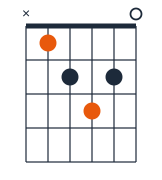
x12320open position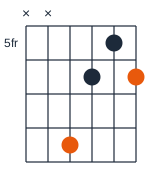
xx8656fret 5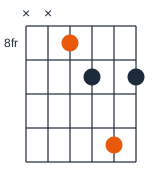
x-x-8-9-11-9fret 8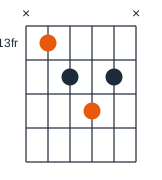
x-13-14-15-14-xfret 13On the ukulele
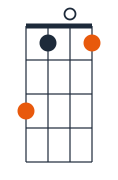
3101open position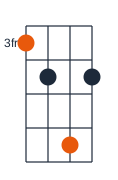
3464fret 3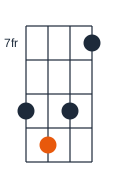
9-10-9-7fret 7On the piano
On the staff
On bass and as an arpeggio
3Indications: what it is used for
The vii° chord of a major key and the ii° chord of a minor key are diminished triads. It works as a leading-tone chord resolving to the tonic (vii°–I), as a passing chord between two diatonic chords (for example between I and ii, or IV and V), and as an incomplete dominant seventh: the vii° triad contains the 3, 5 and 7 of V7. Classical, jazz, gospel and film music use it for tension and chromatic movement in the bass.
4Dosage: how to practise it
On piano, play the triad in all inversions at 60 BPM, then practise vii°6–I resolutions with smooth voice leading (the diminished fifth contracting to a third). On guitar, learn the compact three-string shapes on the top strings and the shape rooted on the fifth string. Practise the passing progression I–♯I°–ii–V slowly, then at 80–100 BPM. Arpeggiate 1-♭3-♭5 on bass. Five minutes a day is enough once the shapes are known.
5Warnings and common mistakes
Do not confuse the triad (dim) with the diminished seventh chord (dim7 or °7) or the half-diminished seventh (m7♭5 or ø7): many charts write 'dim' when they mean the four-note dim7, so check the style. The diminished fifth is not a perfect fifth; on guitar, power-chord habits make players play the wrong fifth. In root position the triad can sound harsh; first inversion is the most common classical voicing.
6Interactions with chords, scales and keys
Inversions
- Inversion 1 · B♭dim/D♭ · D♭ – F♭ – B♭
- Inversion 2 · B♭dim/F♭ · F♭ – B♭ – D♭
Scales to play over B♭dim
- A sharp Locrian Mode
- B flat Blues Scale
- B flat Half-Whole Diminished Scale
- B flat Whole-Half Diminished Scale
- B flat Hungarian Minor Scale
- A sharp Altered Scale
Where it appears (keys and Roman numerals)
7Other presentations available
The same chord from every note
Cdim C♯dim Ddim E♭dim Edim Fdim F♯dim Gdim A♭dim Adim Bdim
Other chords on B♭
B♭ B♭m B♭aug B♭sus2 B♭sus4 B♭5 B♭6 B♭m6 B♭7 B♭maj7 B♭m7 B♭m7♭5 B♭dim7 B♭m(maj7) B♭7sus4 B♭add9 B♭m(add9) B♭6/9 B♭9 B♭maj9 B♭m9 B♭11 B♭m11 B♭13 B♭7♭9 B♭7♯9 B♭7♯5 B♭7♭5
Read this leaflet carefully before playing. Keep it near your instrument. Free to use, print and share for personal and educational use.