Package leaflet · Information for the musician · Chord
B flat Power Chord (B♭5)
Strong, neutral and punchy. Only the root and fifth (often plus the octave), with no third, so it is neither major nor minor.
- B♭5
- 2 notes
- x133xx
1Composition: what it contains
B♭ – F
- Symbol
- B♭5
- Also written
- B♭5, B♭(no3)
- Formula
- 1 5
- Same sound as
- A♯5
| Degree | Note | Interval | Semitones |
|---|---|---|---|
| 1 | B♭ | unison | 0 |
| 5 | F | perfect fifth | 7 |
2Appearance: diagrams and sound
On the guitar
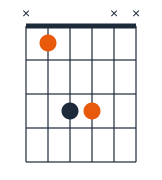
x133xxfret 1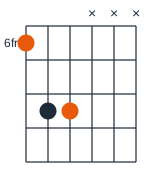
688xxxfret 6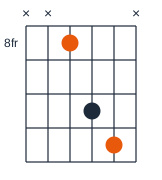
x-x-8-10-11-xfret 8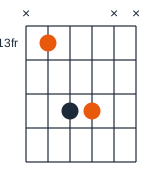
x-13-15-15-x-xfret 13On the ukulele
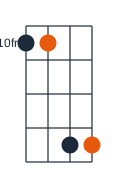
10-10-13-13fret 10On the piano
On the staff
On bass and as an arpeggio
3Indications: what it is used for
The heart of rock, punk, metal and grunge guitar. Because it has no third, it works over both major and minor progressions and stays clear under heavy distortion, which turns thirds into muddy noise. It is used for riffs, palm-muted rhythm parts and doubling bass lines. In other styles it appears as an open fifth on piano or strings for a medieval or epic sound, and as a bass-plus-fifth pattern in left-hand piano accompaniment.
4Dosage: how to practise it
On guitar, learn the two-finger shape rooted on the sixth and fifth strings, then the three-finger shape including the octave. Practise moving it along one string with a metronome at 80 BPM in eighth notes, then add palm muting and increase the tempo to 140–180 BPM for punk downstrokes. Practise switching between the two string sets without looking. On piano, play root and fifth in the left hand under a right-hand melody. Ten minutes daily for beginners.
5Warnings and common mistakes
It is not a major chord, even though it is often written as just a letter by mistake: if the song needs a third, play the full triad. Do not let other strings ring; mute them with the side of the fretting finger. With heavy distortion, add only octaves, not thirds. On drop tunings, the shape changes to a one-finger barre. The symbol '5' refers to the fifth interval above the root, not to a fifth chord in a progression.
6Interactions with chords, scales and keys
Scales to play over B♭5
- B flat Major Scale
- B flat Natural Minor Scale
- B flat Harmonic Minor Scale
- B flat Melodic Minor Scale
- B flat Dorian Mode
- B flat Phrygian Mode
- B flat Lydian Mode
- B flat Mixolydian Mode
- B flat Major Pentatonic Scale
- B flat Minor Pentatonic Scale
- B flat Blues Scale
- B flat Major Blues Scale
- B flat Half-Whole Diminished Scale
- B flat Phrygian Dominant Scale
- B flat Hungarian Minor Scale
- B flat Lydian Dominant Scale
- B flat Double Harmonic Major Scale
- B flat Bebop Dominant Scale
7Other presentations available
The same chord from every note
C5 C♯5 D5 E♭5 E5 F5 F♯5 G5 A♭5 A5 B5
Other chords on B♭
B♭ B♭m B♭dim B♭aug B♭sus2 B♭sus4 B♭6 B♭m6 B♭7 B♭maj7 B♭m7 B♭m7♭5 B♭dim7 B♭m(maj7) B♭7sus4 B♭add9 B♭m(add9) B♭6/9 B♭9 B♭maj9 B♭m9 B♭11 B♭m11 B♭13 B♭7♭9 B♭7♯9 B♭7♯5 B♭7♭5
Read this leaflet carefully before playing. Keep it near your instrument. Free to use, print and share for personal and educational use.