Lessons · Intermediate
Seventh Chords - maj7, 7, m7, m7b5, dim7 and More
How to build and name the main seventh chords, what each one sounds like and where it is used.
Add one more third on top of a triad and you get a seventh chord: root, 3rd, 5th and 7th. That fourth note adds colour and, in some chords, a strong urge to move. Seventh chords are the everyday vocabulary of jazz, soul, R&B, bossa nova and a lot of pop - and the dominant seventh is just as central in classical music, blues and rock.
How seventh chords are built
A seventh chord is a triad plus a 7th above the root. Two things decide its name:
- The triad underneath (major, minor, diminished or augmented).
- The kind of 7th on top: major 7th (11 half steps above the root), minor 7th (10 half steps) or diminished 7th (9 half steps).
| Chord | Symbol on C | Triad | 7th | Formula | Notes |
|---|---|---|---|---|---|
| Major seventh | Cmaj7 | major | major 7th | 1 3 5 7 | C E G B |
| Dominant seventh | C7 | major | minor 7th | 1 3 5 b7 | C E G Bb |
| Minor seventh | Cm7 | minor | minor 7th | 1 b3 5 b7 | C Eb G Bb |
| Half-diminished | Cm7b5 / Cø | diminished | minor 7th | 1 b3 b5 b7 | C Eb Gb Bb |
| Diminished seventh | Cdim7 / C°7 | diminished | diminished 7th | 1 b3 b5 bb7 | C Eb Gb Bbb |
| Minor-major seventh | CmMaj7 | minor | major 7th | 1 b3 5 7 | C Eb G B |
| Augmented seventh | C7#5 / C+7 | augmented | minor 7th | 1 3 #5 b7 | C E G# Bb |
| Augmented major seventh | Cmaj7#5 | augmented | major 7th | 1 3 #5 7 | C E G# B |
Watch the most common confusion: "7" on its own means a minor 7th (dominant seventh). Only "maj7" means a major 7th.
The five essential seventh chords
Major seventh (maj7)
Soft, warm, dreamy. The major 7th sits a half step below the octave, giving a gentle shimmer without tension.
- Symbols: Cmaj7, CM7, CΔ7
- Examples: Fmaj7 = F A C E, Gmaj7 = G B D F#, Ebmaj7 = Eb G Bb D.
- Function: the I and IV chords of a major key.
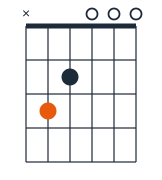
C – E – G – B
Dominant seventh (7)
Bluesy and restless. Between the 3rd and the b7 lies a tritone (B and F in G7), the most unstable interval in tonal music. It wants to resolve: in G7 to C, B rises to C and F falls to E.
- Symbol: C7
- Examples: G7 = G B D F, D7 = D F# A C, E7 = E G# B D, Bb7 = Bb D F Ab.
- Function: the V chord - it pulls strongly to the tonic. In blues, every chord can be a dominant seventh, used for colour rather than resolution.
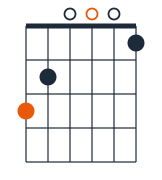
G – B – D – F
Minor seventh (m7)
Mellow, smooth, relaxed - less dramatic than a plain minor triad.
- Symbols: Cm7, Cmin7, C-7
- Examples: Am7 = A C E G, Dm7 = D F A C, Em7 = E G B D, F#m7 = F# A C# E.
- Function: the ii, iii and vi chords of a major key; i in Dorian or Aeolian music.
Half-diminished (m7b5)
Dark and searching. A diminished triad with a minor 7th on top.
- Symbols: Cm7b5, Cø, Cø7
- Examples: Bm7b5 = B D F A, F#m7b5 = F# A C E, Dm7b5 = D F Ab C.
- Function: vii in a major key, and above all ii in a minor key: Bm7b5 - E7 - Am is the classic minor ii - V - i.
Diminished seventh (dim7)
Tense, dramatic, suspenseful. It stacks three minor thirds, so all four notes are equally spaced. Its 7th is a diminished 7th - enharmonically the same sound as a major 6th - which is why Cdim7 is spelled C Eb Gb Bbb but often played as C Eb Gb A.
- Symbols: Cdim7, C°7
- Examples: Bdim7 = B D F Ab, G#dim7 = G# B D F, C#dim7 = C# E G Bb.
- Function: vii°7 in harmonic minor (G#dim7 to Am), and as a passing chord between two chords a whole step apart (C - C#dim7 - Dm).
Because it is symmetrical, there are only three different dim7 sounds. Bdim7, Ddim7, Fdim7 and Abdim7 contain the same four pitches - only the spelling changes.
Other seventh chords worth knowing
Minor-major seventh (mMaj7)
A minor triad with a major 7th: C Eb G B. Mysterious, cinematic, unresolved. It is the i chord of the harmonic and melodic minor scales, and it appears in descending lines like Cm - CmMaj7 - Cm7 - Cm6, where one voice slides down by half steps (C, B, Bb, A).
- Symbols: CmMaj7, Cm(maj7), C-Δ7
7sus4
A dominant seventh with the 3rd replaced by the 4th: C F G Bb. It softens the dominant pull and is common in funk, soul and modal jazz.
Augmented seventh (7#5)
A dominant seventh with a raised 5th: C E G# Bb. The #5 pushes upward toward the 3rd of the next chord - C7#5 to F, where G# moves to A.
Sixth chords
C6 (C E G A) and Cm6 (C Eb G A) add a 6th instead of a 7th. They are not seventh chords, but they fill the same role as a richer tonic, especially in swing and older pop styles.
Seventh chords in a major key
Stacking four notes on each degree of the C major scale gives the same pattern in every major key:
| Degree | Imaj7 | ii7 | iii7 | IVmaj7 | V7 | vi7 | viiø7 |
|---|---|---|---|---|---|---|---|
| C major | Cmaj7 | Dm7 | Em7 | Fmaj7 | G7 | Am7 | Bm7b5 |
| G major | Gmaj7 | Am7 | Bm7 | Cmaj7 | D7 | Em7 | F#m7b5 |
There is only one dominant seventh per major key - on the 5th degree. That is why a dominant seventh points so clearly to its key. Listen to the most important seventh-chord progression of all, the ii - V - I:
On the bass
On bass, a seventh chord becomes a four-note arpeggio, 1-3-5-7. Learning the shapes for maj7, 7, m7 and m7b5 lets you outline any chord chart. Here is the ii - V - I in C, played in one area of the neck so the hand barely moves:
The same chord tones are the raw material of a walking bass line: root on beat 1, other chord tones on beats 2 and 3, and an approach note on beat 4. Hear a generated walking line over the ii - V - I:
Continue with arpeggios on the bass and walking bass.
Practice
- Spell Cmaj7, C7, Cm7, Cm7b5 and Cdim7, then do the same on F, G and D. Check: Gm7b5 = G Bb Db F; Dmaj7 = D F# A C#; Fdim7 = F Ab Cb Ebb (usually played as F Ab B D).
- Play C7 resolving to F, then G7 resolving to C. Watch the 3rd move up a half step and the 7th move down.
- Play the ii - V - I in three keys: C, F and Bb.
- Name: A C# E G, E G B D, F# A C E, D F# A C#. (Answers: A7, Em7, F#m7b5, Dmaj7.)
Tools and further study:
- Build and compare chords with the chord builder and check spellings with the chord identifier.
- Spelling drill: sevenths 1.
- Bass players: walk through changes with walking ii-V-I.
- Play ii - V - I in any key with the progression player.
- Print the chord formulas chart.
- Chord pages: Cmaj7, G7, Dm7, Bm7b5, Bdim7, CmMaj7.
- Related lessons: triads, chord inversions, diatonic harmony, cadences.