Lessons · Beginner
Triads - Major, Minor, Diminished, Augmented and Sus
The five basic three-note chords, how to build and spell them, and what they sound like.
A triad is a chord of three notes stacked in thirds: a root, a third and a fifth. Almost every chord you will ever play - from an open G on guitar to a lush jazz voicing - is a triad at heart, sometimes with extra notes on top. Learn the four triad types (plus the two suspended chords) and you can build and name a huge number of chords on any instrument.
You will need to know intervals, especially major and minor thirds.
Stacking thirds
Take any note as the root, skip a letter, take the next, skip a letter, take the next. From C: C (D) E (F) G. That gives the letters of every C triad: some kind of C, some kind of E and some kind of G.
The quality of the triad depends on the size of the two thirds:
- Major third (M3) = 4 half steps
- Minor third (m3) = 3 half steps
There are four ways to stack two thirds, and so four triad types.
| Triad | Lower third | Upper third | Root to 5th | Formula | On C |
|---|---|---|---|---|---|
| Major | M3 | m3 | perfect 5th | 1 3 5 | C E G |
| Minor | m3 | M3 | perfect 5th | 1 b3 5 | C Eb G |
| Diminished | m3 | m3 | diminished 5th | 1 b3 b5 | C Eb Gb |
| Augmented | M3 | M3 | augmented 5th | 1 3 #5 | C E G# |
Major triad
The major triad is bright, stable and resolved. It is the foundation of major keys.
- Formula: 1 3 5
- Symbol: just the letter - C. Sometimes written CM or Cmaj.
- Examples: G = G B D, D = D F# A, F = F A C, E = E G# B, Bb = Bb D F.
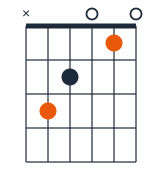
C – E – G
Minor triad
Lower the third of a major triad by a half step and you get a minor triad. It sounds darker, sadder or more serious, but it is just as stable as major.
- Formula: 1 b3 5
- Symbols: Cm, Cmin, C-
- Examples: Am = A C E, Em = E G B, Dm = D F A, F#m = F# A C#, Gm = G Bb D.
Compare the two by ear. Only one note moves, but the mood changes completely:
Diminished triad
Lower both the third and the fifth: two minor thirds stacked. The interval from root to fifth is a diminished 5th (a tritone), which makes this chord tense and unstable. It wants to move on.
- Formula: 1 b3 b5
- Symbols: Cdim, C°
- Examples: Bdim = B D F, F#dim = F# A C, C#dim = C# E G, G#dim = G# B D.
The diminished triad appears naturally on the 7th degree of every major key (B diminished in C major), where it acts like a dominant chord pulling to the tonic.
Augmented triad
Raise the fifth of a major triad: two major thirds stacked. The augmented 5th gives a suspenseful, dreamy or unresolved sound.
- Formula: 1 3 #5
- Symbols: Caug, C+, sometimes C(#5)
- Examples: Caug = C E G#, Faug = F A C#, Gaug = G B D#, Ebaug = Eb G B.
The augmented triad divides the octave into three equal major thirds, so it is symmetrical: Caug, Eaug and G#aug (Abaug) contain the same three notes. It often appears as a passing chord, for example C - Caug - F, where the G# moves smoothly up to A.
Suspended triads: sus2 and sus4
A suspended chord replaces the third with either the 2nd or the 4th. With no third, it is neither major nor minor - open, ambiguous and slightly unresolved.
| Chord | Formula | On C | On D | On A |
|---|---|---|---|---|
| sus2 | 1 2 5 | C D G | D E A | A B E |
| sus4 | 1 4 5 | C F G | D G A | A D E |
- Symbols: Csus2, Csus4 (plain Csus usually means sus4).
- Strictly speaking, sus chords are not stacked in thirds, but they are used like triads.
- Traditionally the 4th "resolves" down to the 3rd: Dsus4 to D is one of the most common guitar moves.
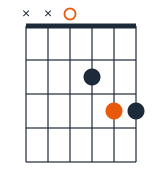
D – G – A
Spelling triads correctly
Each triad must use three different letters, every other letter of the alphabet. This rule keeps the spelling correct even in awkward keys:
- E major is E G# B, not E Ab B.
- Ab minor is Ab Cb Eb, not Ab B Eb - the third of an A-something chord is always some kind of C.
- Fdim is F Ab Cb, not F Ab B.
- G#aug is G# B# D## in strict spelling - which is why musicians usually write it as Abaug (Ab C E).
A good method: first write the major triad, then alter it.
- Write the letters: root, skip one, next, skip one, next.
- Make it major (use the major scale of the root: notes 1, 3 and 5).
- Minor: lower the 3rd. Diminished: lower the 3rd and 5th. Augmented: raise the 5th.
Triads in a key
When you build a triad on every note of a major scale using only notes of that scale, the qualities always follow the same pattern: major, minor, minor, major, major, minor, diminished. In C major: C, Dm, Em, F, G, Am, Bdim. This is the starting point of diatonic harmony.
On the bass
Bass players rarely strum chords; they play triads one note at a time as arpeggios. Each triad type has its own movable shape. From a root on string 3 or 4, the major 3rd is one string up and one fret lower, the minor 3rd three frets higher on the same string, and the perfect 5th one string up and two frets higher.
Play the diatonic triads of C major this way, one bar each, and you hear the major, minor and diminished qualities from the bottom up. Shapes, fingerings and seventh arpeggios are in arpeggios on the bass.
Practice
- Spell the major, minor, diminished and augmented triads on G, D, F and Bb. Check: Bb minor = Bb Db F; Gaug = G B D#; Ddim = D F Ab.
- Play a C major triad, then change one note at a time to make C minor, C diminished, C augmented, Csus2 and Csus4.
- On guitar or piano, play D - Dsus4 - D - Dsus2 - D and listen to the tension and release.
- Name these triads: A C# E, B D F#, E G Bb, F A C#. (Answers: A, Bm, Edim, Faug.)
Go further:
- Build any triad on guitar, piano or staff with the chord builder, or reverse it with the chord identifier.
- Hear the difference between qualities in the ear trainer.
- Test your spelling: triads 1 and triads 2.
- Guitarists: practise triad shapes with guitar arpeggios; bassists: bass arpeggios.
- Print the chord formulas chart and some blank chord boxes.
- Look up chords such as A minor, B diminished or E augmented.
- Next lessons: seventh chords, chord inversions, diatonic harmony.