Package leaflet · Information for the musician · Chord
E Augmented Chord (Eaug)
Suspenseful, dreamy and unresolved. Two stacked major thirds create a raised fifth that pushes upward.
- Eaug
- 3 notes
- 032110
1Composition: what it contains
E – G♯ – B♯
- Symbol
- Eaug
- Also written
- Eaug, E+, E(♯5)
- Formula
- 1 3 ♯5
| Degree | Note | Interval | Semitones |
|---|---|---|---|
| 1 | E | unison | 0 |
| 3 | G♯ | major third | 4 |
| ♯5 | B♯ | augmented fifth | 8 |
2Appearance: diagrams and sound
On the guitar
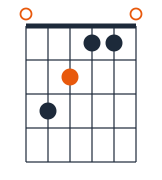
032110open position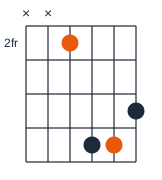
xx2554fret 2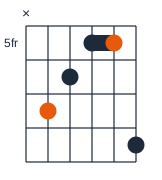
x76558fret 5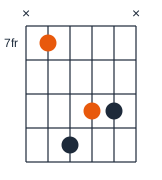
x-7-10-9-9-xfret 7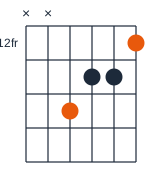
x-x-14-13-13-12fret 12On the ukulele
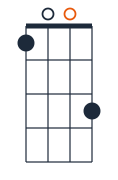
1003open position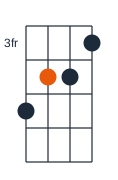
5443fret 3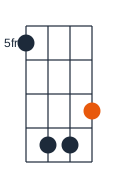
5887fret 5On the piano
On the staff
On bass and as an arpeggio
3Indications: what it is used for
Appears as III+ in harmonic minor and as a chromatic passing chord: the raised fifth moving between the fifth and sixth (I–I+–I6–I7 or I–I+–IV) creates the classic line cliché. It works as a dominant substitute (V+ resolving to I), in ballads, jazz standards, film music for mystery or dreams, and in some pop and rock intros. Because it divides the octave into three equal parts, there are only four different augmented triads, and any note can be heard as the root.
4Dosage: how to practise it
On guitar, learn the compact four-string shape and move it up by four frets: the inversion is the same chord. On piano, play it in all inversions and notice that every inversion looks alike. Practise I–I+–vi or I–I+–IV at 60–80 BPM to hear the rising chromatic line. Arpeggiate it as two major thirds on bass. Combine it with whole-tone scale practice for ten minutes, since the augmented triad belongs to that scale.
5Warnings and common mistakes
Do not confuse '+' with 'add': '+' means a raised fifth, not an added note. The raised fifth is spelled as ♯5, not as ♭6, which would describe a different chord. It is not the same as a dominant seventh with a raised fifth (7♯5 or aug7), which adds the flat seventh. On guitar, open-string shapes may accidentally include a perfect fifth, which destroys the augmented sound.
6Interactions with chords, scales and keys
Inversions
- Inversion 1 · Eaug/G♯ · G♯ – B♯ – E
- Inversion 2 · Eaug/B♯ · B♯ – E – G♯
Scales to play over Eaug
7Other presentations available
The same chord from every note
Caug C♯aug Daug E♭aug Faug F♯aug Gaug A♭aug Aaug B♭aug Baug
Other chords on E
E Em Edim Esus2 Esus4 E5 E6 Em6 E7 Emaj7 Em7 Em7♭5 Edim7 Em(maj7) E7sus4 Eadd9 Em(add9) E6/9 E9 Emaj9 Em9 E11 Em11 E13 E7♭9 E7♯9 E7♯5 E7♭5
Read this leaflet carefully before playing. Keep it near your instrument. Free to use, print and share for personal and educational use.