Package leaflet · Information for the musician · Chord
E Minor Added Ninth Chord (Em(add9))
Wistful, tender and atmospheric. A minor triad with an added ninth, minor colour with an open, poignant shimmer.
- Em(add9)
- 4 notes
- 024000
1Composition: what it contains
E – G – B – F♯
- Symbol
- Em(add9)
- Also written
- Emadd9, Em(add9), E-add9, Emadd2
- Formula
- 1 ♭3 5 9
| Degree | Note | Interval | Semitones |
|---|---|---|---|
| 1 | E | unison | 0 |
| ♭3 | G | minor third | 3 |
| 5 | B | perfect fifth | 7 |
| 9 | F♯ | major ninth | 14 |
2Appearance: diagrams and sound
On the guitar
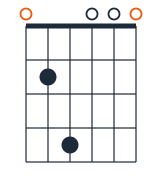
024000open position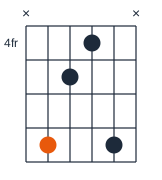
x7547xfret 4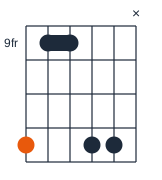
12-9-9-12-12-xfret 9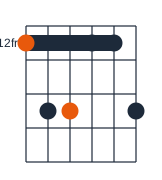
12-14-14-12-12-14fret 12On the ukulele
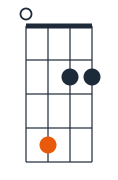
0422open position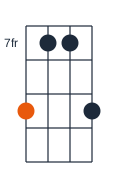
9779fret 7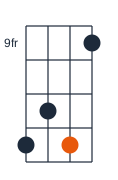
12-11-12-9fret 9On the piano
On the staff
On bass and as an arpeggio
3Indications: what it is used for
Used in pop ballads, film scores, worship music, ambient, post-rock and progressive rock as a more emotional version of a minor chord, typically on i, iv or vi. The ninth rubbing against the minor third gives a bittersweet tension. It is easy to play on guitar with open strings and popular in arpeggiated intros. In jazz it is less common than m9, which adds the seventh. Aeolian or Dorian scales fit over it.
4Dosage: how to practise it
On guitar, learn the stretch shape rooted on the fifth string and the open-string versions; arpeggiate them slowly at 60–80 BPM so every note rings. On piano, play root-2-♭3-5 in close position, then spread versions (root-5 in the left hand, 9-♭3 in the right). Practise progressions such as i–VI–III–VII with madd9 on minor chords. Five minutes a day, comparing m, madd9 and m9. On bass, stay on the root and fifth and let the guitar or piano carry the ninth.
5Warnings and common mistakes
Do not confuse madd9 with m9, which includes the flat seventh. The ninth sits a half step above the minor third in close position, which can sound clashing; spread the voicing if it sounds too dense. The guitar stretch can be hard for small hands; build up slowly to avoid strain. Check that you are not playing a major third by mistake when adapting add9 shapes.
6Interactions with chords, scales and keys
Inversions
- Inversion 1 · Em(add9)/G · G – B – F♯ – E
- Inversion 2 · Em(add9)/B · B – F♯ – E – G
- Inversion 3 · Em(add9)/F♯ · F♯ – E – G – B
Scales to play over Em(add9)
7Other presentations available
The same chord from every note
Cm(add9) C♯m(add9) Dm(add9) E♭m(add9) Fm(add9) F♯m(add9) Gm(add9) A♭m(add9) Am(add9) B♭m(add9) Bm(add9)
Other chords on E
E Em Edim Eaug Esus2 Esus4 E5 E6 Em6 E7 Emaj7 Em7 Em7♭5 Edim7 Em(maj7) E7sus4 Eadd9 E6/9 E9 Emaj9 Em9 E11 Em11 E13 E7♭9 E7♯9 E7♯5 E7♭5
Read this leaflet carefully before playing. Keep it near your instrument. Free to use, print and share for personal and educational use.