Package leaflet · Information for the musician · Chord
C Minor Major Seventh Chord (Cm(maj7))
Haunting, mysterious and cinematic. A minor triad with a major seventh: the sound of spy movies and film-noir.
- Cm(maj7)
- 4 notes
- x31003
1Composition: what it contains
C – E♭ – G – B
- Symbol
- Cm(maj7)
- Also written
- CmMaj7, Cm(maj7), C-Δ7, CmM7, Cmin(maj7)
- Formula
- 1 ♭3 5 7
| Degree | Note | Interval | Semitones |
|---|---|---|---|
| 1 | C | unison | 0 |
| ♭3 | E♭ | minor third | 3 |
| 5 | G | perfect fifth | 7 |
| 7 | B | major seventh | 11 |
2Appearance: diagrams and sound
On the guitar
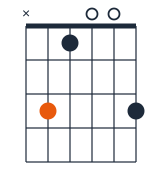
x31003open position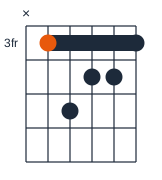
x35443fret 3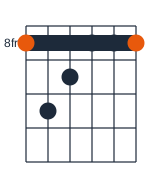
8-10-9-8-8-8fret 8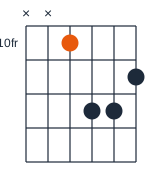
x-x-10-12-12-11fret 10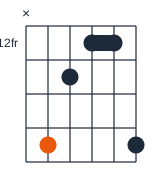
x-15-13-12-12-15fret 12On the ukulele
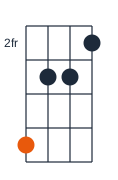
5332fret 2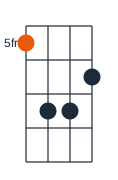
5776fret 5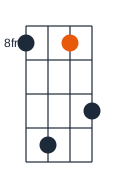
8-11-8-10fret 8On the piano
On the staff
On bass and as an arpeggio
3Indications: what it is used for
The tonic chord of the harmonic and melodic minor scales, used as a i chord in jazz and film music. It appears in the minor line cliché (i–imMaj7–im7–im6), where the descending chromatic line passes through it. Jazz players use it as a tonic minor colour at the end of a minor ii–V–i, and film composers use it for suspense or mystery. Melodic minor (jazz minor) is the typical scale over it.
4Dosage: how to practise it
On guitar, learn the shape rooted on the fifth string and the drop-2 voicing on the top strings. On piano, play root-♭3-5-7 in all inversions, then practise the line cliché i–imMaj7–im7–im6 at 60–80 BPM, keeping the moving voice clear. Improvise over the chord using melodic minor. Arpeggiate the chord in two octaves. Five minutes daily, alternating with m7 to train your ear. On bass, outline 1-♭3-5-7 and let the major seventh lead back up to the root. Compare the chord with the minor sixth and minor seventh in the same session.
5Warnings and common mistakes
The seventh is major: do not confuse it with m7. The major seventh and minor third are a major third apart and form an augmented triad on top, which can sound dissonant in close voicings; spread them out. Avoid doubling the major seventh. Symbols vary widely (mMaj7, m(maj7), -Δ7), which can confuse readers. It is unstable as a passing chord, so resolve it to m7, m6 or the tonic.
6Interactions with chords, scales and keys
Inversions
- Inversion 1 · Cm(maj7)/E♭ · E♭ – G – B – C
- Inversion 2 · Cm(maj7)/G · G – B – C – E♭
- Inversion 3 · Cm(maj7)/B · B – C – E♭ – G
Scales to play over Cm(maj7)
7Other presentations available
The same chord from every note
C♯m(maj7) Dm(maj7) E♭m(maj7) Em(maj7) Fm(maj7) F♯m(maj7) Gm(maj7) A♭m(maj7) Am(maj7) B♭m(maj7) Bm(maj7)
Other chords on C
C Cm Cdim Caug Csus2 Csus4 C5 C6 Cm6 C7 Cmaj7 Cm7 Cm7♭5 Cdim7 C7sus4 Cadd9 Cm(add9) C6/9 C9 Cmaj9 Cm9 C11 Cm11 C13 C7♭9 C7♯9 C7♯5 C7♭5
Read this leaflet carefully before playing. Keep it near your instrument. Free to use, print and share for personal and educational use.