Package leaflet · Information for the musician · Chord
C Half-Diminished Seventh Chord (Cm7♭5)
Yearning, dark and unresolved. A diminished triad with a minor seventh, softer than a full diminished seventh.
- Cm7♭5
- 4 notes
- x31312
1Composition: what it contains
C – E♭ – G♭ – B♭
- Symbol
- Cm7♭5
- Also written
- Cm7♭5, Cø, Cø7, C-7♭5, Cmi7(♭5)
- Formula
- 1 ♭3 ♭5 ♭7
| Degree | Note | Interval | Semitones |
|---|---|---|---|
| 1 | C | unison | 0 |
| ♭3 | E♭ | minor third | 3 |
| ♭5 | G♭ | diminished fifth | 6 |
| ♭7 | B♭ | minor seventh | 10 |
2Appearance: diagrams and sound
On the guitar
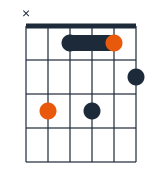
x31312fret 1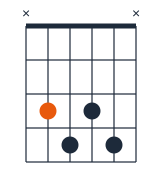
x3434xfret 3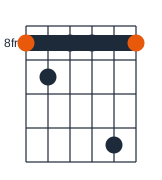
8-9-8-8-11-8fret 8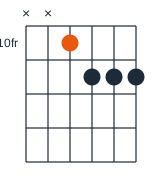
x-x-10-11-11-11fret 10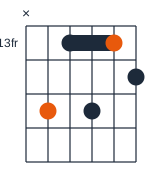
x-15-13-15-13-14fret 13On the ukulele
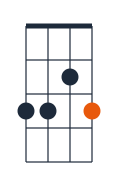
3323fret 2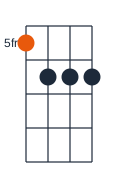
5666fret 5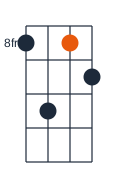
8-10-8-9fret 8On the piano
On the staff
On bass and as an arpeggio
3Indications: what it is used for
The iiø7 chord of a minor key: in a minor ii–V–i it leads to V7(♭9) and then to i. It is also the vii chord of a major key (viiø7), used as a dominant-function chord resolving to I. In jazz it appears in minor ii–V's and as a passing chord; in classical music it is a common pre-dominant. Locrian or Locrian ♮2 is the usual scale. It shares notes with the minor sixth chord built a minor third above its root.
4Dosage: how to practise it
On guitar, learn the shape rooted on the fifth string (the most common), the shape rooted on the sixth string with the fifth string muted, and drop-2 voicings. On piano, play it in all inversions and in the minor ii–V–i progression with smooth voice leading. Practise the minor ii–V–i around the circle of fifths at 70–120 BPM. Arpeggiate 1-♭3-♭5-♭7. Five to ten minutes daily, alternating with the diminished seventh to hear the difference.
5Warnings and common mistakes
Do not confuse m7♭5 (half-diminished) with dim7 (fully diminished): the seventh is minor here and diminished in the dim7. On guitar, check that the fifth is really flat; muscle memory from m7 shapes often keeps a perfect fifth. Do not mix up the symbol ø (half-diminished, slashed circle) with ° (diminished). When improvising, the flat second (♭9) is the avoid note.
6Interactions with chords, scales and keys
Inversions
- Inversion 1 · Cm7♭5/E♭ · E♭ – G♭ – B♭ – C
- Inversion 2 · Cm7♭5/G♭ · G♭ – B♭ – C – E♭
- Inversion 3 · Cm7♭5/B♭ · B♭ – C – E♭ – G♭
Scales to play over Cm7♭5
Where it appears (keys and Roman numerals)
7Other presentations available
The same chord from every note
C♯m7♭5 Dm7♭5 E♭m7♭5 Em7♭5 Fm7♭5 F♯m7♭5 Gm7♭5 A♭m7♭5 Am7♭5 B♭m7♭5 Bm7♭5
Other chords on C
C Cm Cdim Caug Csus2 Csus4 C5 C6 Cm6 C7 Cmaj7 Cm7 Cdim7 Cm(maj7) C7sus4 Cadd9 Cm(add9) C6/9 C9 Cmaj9 Cm9 C11 Cm11 C13 C7♭9 C7♯9 C7♯5 C7♭5
Read this leaflet carefully before playing. Keep it near your instrument. Free to use, print and share for personal and educational use.