Package leaflet · Information for the musician · Chord
C Seventh Sharp Nine Chord (C7♯9)
Gritty, funky and aggressive. The sharp ninth rubs against the major third, combining major and minor colours in one chord.
- C7♯9
- 5 notes
- x31310
1Composition: what it contains
C – E – G – B♭ – D♯
- Symbol
- C7♯9
- Also written
- C7♯9, C7(♯9), C7+9
- Formula
- 1 3 5 ♭7 ♯9
| Degree | Note | Interval | Semitones |
|---|---|---|---|
| 1 | C | unison | 0 |
| 3 | E | major third | 4 |
| 5 | G | perfect fifth | 7 |
| ♭7 | B♭ | minor seventh | 10 |
| ♯9 | D♯ | augmented ninth | 15 |
2Appearance: diagrams and sound
On the guitar
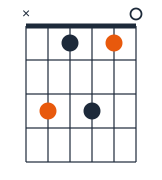
x31310open position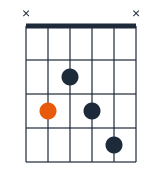
x3234xfret 2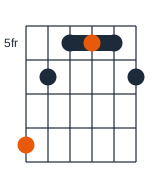
865556fret 5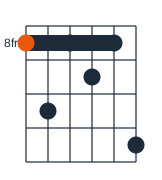
8-10-8-9-8-11fret 8On the ukulele
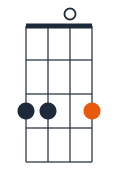
3303open position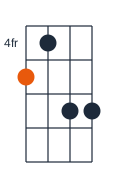
5466fret 4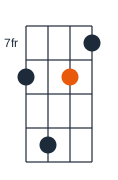
8-10-8-7fret 7On the piano
On the staff
On bass and as an arpeggio
3Indications: what it is used for
Famous in rock, funk, blues-rock and soul as a tonic dominant chord with attitude, and in jazz as an altered V7 resolving to I or i. Its sharp ninth is enharmonic to the minor third, so it suits minor-pentatonic soloing over a dominant groove. In jazz, the altered scale or half-whole diminished scale fits over it. It frequently appears in blues and funk vamps and as the V chord in minor ii–V–i progressions.
4Dosage: how to practise it
On guitar, learn the classic shape rooted on the fifth string (root, 3, ♭7, ♯9) and practise funk rhythms at 90–120 BPM, muting between hits. On piano, play the left-hand voicing 3-♭7-♯9 and the right-hand altered voicings. Practise iiø7–V7♯9–im and a twelve-bar blues with every chord as 7♯9. Arpeggiate the chord. Five to ten minutes daily. On piano, practise comping with short, accented hits. Try improvising with the blues scale over a 7♯9 vamp, then with the altered scale, to hear both colours.
5Warnings and common mistakes
The sharp ninth is not a minor third: it sits above the major third, which must also be present. Do not confuse 7♯9 with m7, which has no major third. Avoid placing the ♯9 below the third in voicings, which turns the sound into a muddy minor chord. In a major ii–V–I, the sharp ninth may clash with a melody containing the natural ninth. The symbol '7+9' is ambiguous; prefer 7♯9.
6Interactions with chords, scales and keys
Inversions
- Inversion 1 · C7♯9/E · E – G – B♭ – D♯ – C
- Inversion 2 · C7♯9/G · G – B♭ – D♯ – C – E
- Inversion 3 · C7♯9/B♭ · B♭ – D♯ – C – E – G
- Inversion 4 · C7♯9/D♯ · D♯ – C – E – G – B♭
Scales to play over C7♯9
7Other presentations available
The same chord from every note
C♯7♯9 D7♯9 E♭7♯9 E7♯9 F7♯9 F♯7♯9 G7♯9 A♭7♯9 A7♯9 B♭7♯9 B7♯9
Other chords on C
C Cm Cdim Caug Csus2 Csus4 C5 C6 Cm6 C7 Cmaj7 Cm7 Cm7♭5 Cdim7 Cm(maj7) C7sus4 Cadd9 Cm(add9) C6/9 C9 Cmaj9 Cm9 C11 Cm11 C13 C7♭9 C7♯5 C7♭5
Read this leaflet carefully before playing. Keep it near your instrument. Free to use, print and share for personal and educational use.