Package leaflet · Information for the musician · Chord
C Seventh Flat Nine Chord (C7♭9)
Dark, dramatic and exotic. A dominant seventh with a flat ninth, full of tension that resolves strongly, especially to minor.
- C7♭9
- 5 notes
- x32320
1Composition: what it contains
C – E – G – B♭ – D♭
- Symbol
- C7♭9
- Also written
- C7♭9, C7(♭9), C7-9
- Formula
- 1 3 5 ♭7 ♭9
| Degree | Note | Interval | Semitones |
|---|---|---|---|
| 1 | C | unison | 0 |
| 3 | E | major third | 4 |
| 5 | G | perfect fifth | 7 |
| ♭7 | B♭ | minor seventh | 10 |
| ♭9 | D♭ | minor ninth | 13 |
2Appearance: diagrams and sound
On the guitar
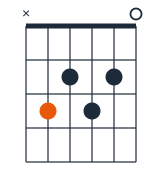
x32320open position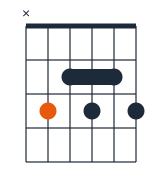
x32323fret 2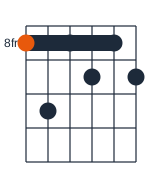
8-10-8-9-8-9fret 8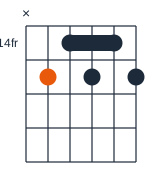
x-15-14-15-14-15fret 14On the ukulele
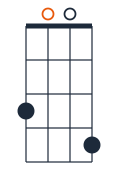
3004open position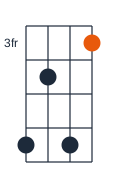
6463fret 3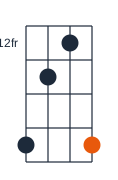
15-13-12-15fret 12On the piano
On the staff
On bass and as an arpeggio
3Indications: what it is used for
The V7♭9 chord of a minor key, resolving to i: it comes from harmonic minor (or phrygian dominant on the fifth degree). Used in jazz (minor ii–V–i), classical, flamenco, tango, gospel and film music. It can be used in major keys for extra tension, and the diminished seventh chord a half step above its root is the same chord without its root. Half-whole diminished or phrygian dominant are typical scales over it.
4Dosage: how to practise it
On guitar, learn the four-string shape rooted on the fifth string, and practise the trick of playing a diminished seventh shape over the root. On piano, play rootless voicings 3-♭7-♭9 and the 13♭9 voicing. Practise iiø7–V7♭9–im at 60–120 BPM in all keys, with smooth voice leading. Arpeggiate 1-3-5-♭7-♭9. Ten minutes daily. On guitar, practise resolving the ♭9 down by half step to the fifth of the target minor chord. Compare the chord with plain dominant sevenths and with 7♯9 to hear the difference in tension.
5Warnings and common mistakes
Avoid voicing the root and the flat ninth a half step apart: keep the root in the bass and the ♭9 high in the voicing. Do not confuse 7♭9 with dim7, which shares notes but has no root. Do not use it when the melody holds the natural ninth. The symbol '7-9' can be misread; prefer 7♭9. Avoid mixing the flat ninth with a natural ninth in the same voicing.
6Interactions with chords, scales and keys
Inversions
- Inversion 1 · C7♭9/E · E – G – B♭ – D♭ – C
- Inversion 2 · C7♭9/G · G – B♭ – D♭ – C – E
- Inversion 3 · C7♭9/B♭ · B♭ – D♭ – C – E – G
- Inversion 4 · C7♭9/D♭ · D♭ – C – E – G – B♭
Scales to play over C7♭9
7Other presentations available
The same chord from every note
C♯7♭9 D7♭9 E♭7♭9 E7♭9 F7♭9 F♯7♭9 G7♭9 A♭7♭9 A7♭9 B♭7♭9 B7♭9
Other chords on C
C Cm Cdim Caug Csus2 Csus4 C5 C6 Cm6 C7 Cmaj7 Cm7 Cm7♭5 Cdim7 Cm(maj7) C7sus4 Cadd9 Cm(add9) C6/9 C9 Cmaj9 Cm9 C11 Cm11 C13 C7♯9 C7♯5 C7♭5
Read this leaflet carefully before playing. Keep it near your instrument. Free to use, print and share for personal and educational use.