Package leaflet · Information for the musician · Chord
D Major Chord (D)
Stable, bright and complete. The basic consonant triad of Western music: root, major third and perfect fifth.
- D
- 3 notes
- xx0232
1Composition: what it contains
D – F♯ – A
- Symbol
- D
- Also written
- D, DM, Dmaj, DΔ
- Formula
- 1 3 5
| Degree | Note | Interval | Semitones |
|---|---|---|---|
| 1 | D | unison | 0 |
| 3 | F♯ | major third | 4 |
| 5 | A | perfect fifth | 7 |
2Appearance: diagrams and sound
On the guitar
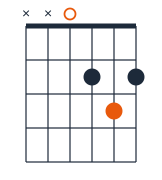
xx0232open position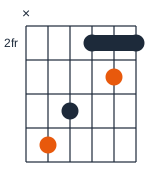
x54232fret 2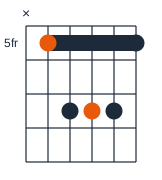
x57775fret 5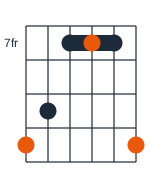
10-9-7-7-7-10fret 7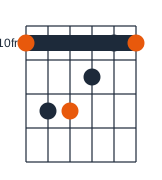
10-12-12-11-10-10fret 10On the ukulele
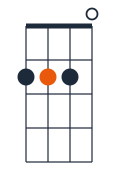
2220open position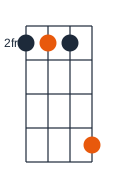
2225fret 2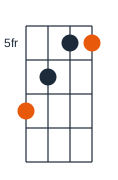
7655fret 5On the piano
On the staff
On bass and as an arpeggio
3Indications: what it is used for
The I, IV and V chords of every major key are major triads, so it is the backbone of pop, rock, folk, country, gospel and classical harmony. In minor keys it appears as III, VI and VII, and as the major V chord borrowed from harmonic minor. Progressions like I–IV–V, I–V–vi–IV and I–♭VII–IV rely on it. It can be replaced by a major seventh, sixth, add9 or 6/9 chord for a richer colour, or by its relative minor (vi for I) in reharmonisation.
4Dosage: how to practise it
On guitar, learn the open shapes first, then the barre shapes with the root on the sixth and fifth strings, and finally the small triad shapes on the top three strings in all three inversions. On piano, play root position, first and second inversion with each hand at 60 BPM, then move through I–IV–V with the smoothest voice leading. On bass, arpeggiate 1-3-5-8 and back. Spend five minutes daily switching between two chords on every beat, raising the tempo by 5 BPM when the change is clean.
5Warnings and common mistakes
Do not confuse it with the minor triad: only the third changes, and that one half step changes everything. Doubling the third in thick voicings can sound heavy; double the root or fifth instead. On guitar, check that the third is actually present in power-chord-like shapes. A chord symbol with just the letter means major: an 'M' or 'maj' written alone is the same chord, but 'M7' or 'maj7' adds a seventh.
6Interactions with chords, scales and keys
Inversions
- Inversion 1 · D/F♯ · F♯ – A – D
- Inversion 2 · D/A · A – D – F♯
Scales to play over D
- D Major Scale
- D Lydian Mode
- D Mixolydian Mode
- D Major Pentatonic Scale
- D Major Blues Scale
- D Half-Whole Diminished Scale
- D Phrygian Dominant Scale
- D Lydian Dominant Scale
- D Double Harmonic Major Scale
- D Bebop Dominant Scale
Where it appears (keys and Roman numerals)
7Other presentations available
The same chord from every note
Other chords on D
Dm Ddim Daug Dsus2 Dsus4 D5 D6 Dm6 D7 Dmaj7 Dm7 Dm7♭5 Ddim7 Dm(maj7) D7sus4 Dadd9 Dm(add9) D6/9 D9 Dmaj9 Dm9 D11 Dm11 D13 D7♭9 D7♯9 D7♯5 D7♭5
Read this leaflet carefully before playing. Keep it near your instrument. Free to use, print and share for personal and educational use.