Package leaflet · Information for the musician · Chord
D Dominant Thirteenth Chord (D13)
Bright, rich and swinging. A dominant seventh with the thirteenth on top, the fullest natural dominant sound.
- D13
- 6 notes
- xx0412
1Composition: what it contains
D – F♯ – A – C – E – B
- Symbol
- D13
- Also written
- D13, D7(13), Ddom13
- Formula
- 1 3 5 ♭7 9 13
| Degree | Note | Interval | Semitones |
|---|---|---|---|
| 1 | D | unison | 0 |
| 3 | F♯ | major third | 4 |
| 5 | A | perfect fifth | 7 |
| ♭7 | C | minor seventh | 10 |
| 9 | E | major ninth | 14 |
| 13 | B | major thirteenth | 21 |
2Appearance: diagrams and sound
On the guitar
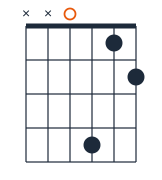
xx0412open position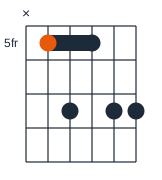
x57577fret 5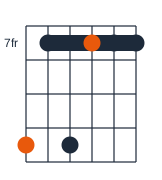
10-7-10-7-7-7fret 7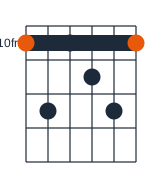
10-12-10-11-12-10fret 10On the ukulele
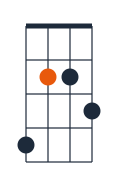
4223fret 2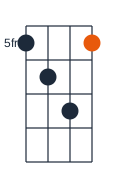
5675fret 5On the piano
On the staff
On bass and as an arpeggio
3Indications: what it is used for
A staple of jazz, big-band swing, blues, funk, soul and gospel on dominant chords: the V13 in a ii–V–I, I13 and IV13 in jazz blues, and funk vamps. It includes the ninth implicitly in many voicings and usually omits the eleventh (which clashes with the third). Mixolydian is the scale; the thirteenth is the same note as the sixth degree. It can replace any dominant seventh when the melody contains the natural thirteenth or ninth.
4Dosage: how to practise it
On guitar, learn the shape rooted on the sixth string (root, ♭7, 3, 13) and the shape rooted on the fifth string; practise sliding them in from a half step below. On piano, play rootless voicings ♭7-9-3-13 and 3-13-♭7-9 in the left hand. Practise ii9–V13–Imaj9 in all keys at 80–160 BPM with a swing feel. Ten minutes daily. On bass, outline 1-3-5-♭7 and resolve to the next chord. Practise a twelve-bar blues with all dominant chords as thirteenths, comparing them with plain dominant sevenths and ninths.
5Warnings and common mistakes
Do not play the eleventh in a dominant thirteenth chord: it clashes with the major third, so omit it. Do not confuse 13 with 6 (no seventh) or with maj13 (major seventh). The essential notes are the third, flat seventh and thirteenth; the root and fifth can be omitted. If the melody holds the flat thirteenth (for example in minor keys), use 7♭13 or the altered sound instead.
6Interactions with chords, scales and keys
Inversions
- Inversion 1 · D13/F♯ · F♯ – A – C – E – B – D
- Inversion 2 · D13/A · A – C – E – B – D – F♯
- Inversion 3 · D13/C · C – E – B – D – F♯ – A
- Inversion 4 · D13/E · E – B – D – F♯ – A – C
- Inversion 5 · D13/B · B – D – F♯ – A – C – E
Scales to play over D13
7Other presentations available
The same chord from every note
C13 C♯13 E♭13 E13 F13 F♯13 G13 A♭13 A13 B♭13 B13
Other chords on D
D Dm Ddim Daug Dsus2 Dsus4 D5 D6 Dm6 D7 Dmaj7 Dm7 Dm7♭5 Ddim7 Dm(maj7) D7sus4 Dadd9 Dm(add9) D6/9 D9 Dmaj9 Dm9 D11 Dm11 D7♭9 D7♯9 D7♯5 D7♭5
Read this leaflet carefully before playing. Keep it near your instrument. Free to use, print and share for personal and educational use.