Package leaflet · Information for the musician · Chord
D Eleventh Chord (D11)
Open, suspended and gospel-tinged. A dominant chord stacked up to the eleventh, usually without the third, sounding like a rich sus chord.
- D11
- 6 notes
- xx0010
1Composition: what it contains
D – F♯ – A – C – E – G
- Symbol
- D11
- Also written
- D11, D9sus4, D7(11)
- Formula
- 1 3 5 ♭7 9 11
| Degree | Note | Interval | Semitones |
|---|---|---|---|
| 1 | D | unison | 0 |
| 3 | F♯ | major third | 4 |
| 5 | A | perfect fifth | 7 |
| ♭7 | C | minor seventh | 10 |
| 9 | E | major ninth | 14 |
| 11 | G | perfect eleventh | 17 |
2Appearance: diagrams and sound
On the guitar
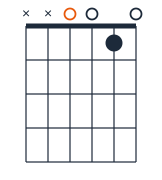
xx0010open position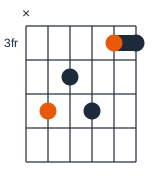
x54533fret 3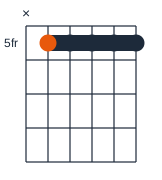
x55555fret 5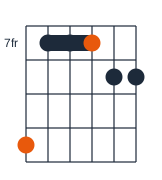
10-7-7-7-8-8fret 7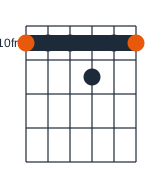
10-10-10-11-10-10fret 10On the ukulele
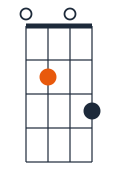
0203open position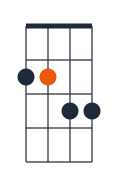
2233fret 2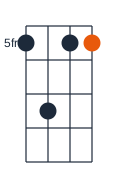
5755fret 5On the piano
On the staff
On bass and as an arpeggio
3Indications: what it is used for
In practice the eleventh chord is usually voiced as a 9sus4: the root, fifth, flat seventh, ninth and eleventh, without the third. It is used as a V chord in gospel, soul, jazz, fusion and pop (often written as a slash chord, the IV chord over the V bass). It works on dominant vamps and as a softer alternative to V7 before resolving to I. Mixolydian fits over it, with the fourth as a chord tone rather than an avoid note.
4Dosage: how to practise it
On piano, play the IV-over-V slash voicing (a major triad whose root lies a whole step below the bass note), and the left-hand voicing ♭7-9-11 over the root. On guitar, learn the shape rooted on the fifth string (root, ♭7, 9, 11) and the shape rooted on the sixth string. Practise V11–I and ii7–V11–Imaj7 progressions at 70–100 BPM. Five minutes daily, comparing 7sus4, 9sus4 and 11. On bass, stay on the root; the voicing above carries the colour.
5Warnings and common mistakes
Avoid playing the major third with the eleventh: they are a minor ninth apart and clash badly, which is why the third is usually dropped. Do not confuse the dominant eleventh with m11 (where the third is minor and the eleventh is consonant). Do not confuse it with add11, which has no seventh. In full six-note voicings the chord sounds muddy; omit the third and sometimes the fifth.
6Interactions with chords, scales and keys
Inversions
- Inversion 1 · D11/F♯ · F♯ – A – C – E – G – D
- Inversion 2 · D11/A · A – C – E – G – D – F♯
- Inversion 3 · D11/C · C – E – G – D – F♯ – A
- Inversion 4 · D11/E · E – G – D – F♯ – A – C
- Inversion 5 · D11/G · G – D – F♯ – A – C – E
Scales to play over D11
7Other presentations available
The same chord from every note
C11 C♯11 E♭11 E11 F11 F♯11 G11 A♭11 A11 B♭11 B11
Other chords on D
D Dm Ddim Daug Dsus2 Dsus4 D5 D6 Dm6 D7 Dmaj7 Dm7 Dm7♭5 Ddim7 Dm(maj7) D7sus4 Dadd9 Dm(add9) D6/9 D9 Dmaj9 Dm9 Dm11 D13 D7♭9 D7♯9 D7♯5 D7♭5
Read this leaflet carefully before playing. Keep it near your instrument. Free to use, print and share for personal and educational use.