Package leaflet · Information for the musician · Chord
D Minor Sixth Chord (Dm6)
Dark, elegant and mysterious. A minor triad with a major sixth, giving a film-noir or gypsy-jazz flavour.
- Dm6
- 4 notes
- xx0201
1Composition: what it contains
D – F – A – B
- Symbol
- Dm6
- Also written
- Dm6, Dmin6, D-6
- Formula
- 1 ♭3 5 6
| Degree | Note | Interval | Semitones |
|---|---|---|---|
| 1 | D | unison | 0 |
| ♭3 | F | minor third | 3 |
| 5 | A | perfect fifth | 7 |
| 6 | B | major sixth | 9 |
2Appearance: diagrams and sound
On the guitar
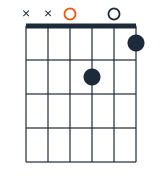
xx0201open position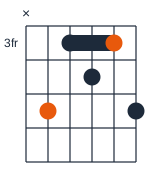
x53435fret 3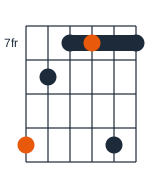
10-8-7-7-10-7fret 7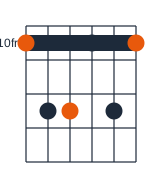
10-12-12-10-12-10fret 10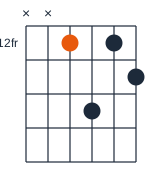
x-x-12-14-12-13fret 12On the ukulele
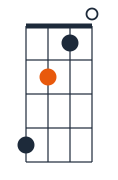
4210open position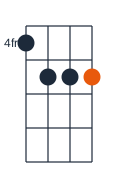
4555fret 4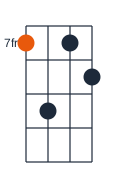
7978fret 7On the piano
On the staff
On bass and as an arpeggio
3Indications: what it is used for
Used as a tonic minor chord in jazz, gypsy jazz, bossa nova, tango and film music, often instead of a minor seventh. It is the i chord built from the melodic minor or Dorian scale, and the iv chord in a minor key (where it is a common pre-dominant). The minor sixth chord shares its notes with the half-diminished chord built on its sixth, which gives interesting reharmonisation possibilities. It also appears in cadences such as iv6–I in major keys (a borrowed minor four).
4Dosage: how to practise it
On guitar, learn the four-string shape rooted on the fifth string and the gypsy-jazz shape with the sixth on top; play them with a light swing at 120–180 BPM. On piano, play root-♭3-5-6 in all inversions and practise the minor line cliché (i–imMaj7–im7–im6). Practise iv6–I endings in major keys. On bass, arpeggiate 1-♭3-5-6. Ten minutes daily, alternating with m7 and mMaj7 to hear the colours. On guitar, also try the tonic m6 as a final chord at the end of a minor tune.
5Warnings and common mistakes
The sixth is major, not minor: m6 is not 'minor with a flat sixth'. Do not confuse it with m7♭5: same notes, different root, so the bass decides the name. In minor keys built on natural minor, the sixth degree is flat, so an m6 tonic implies melodic minor or Dorian. Avoid it if the melody contains the flat sixth. Some charts write 'm6' meaning m6/9; check the melody.
6Interactions with chords, scales and keys
Inversions
- Inversion 1 · Dm6/F · F – A – B – D
- Inversion 2 · Dm6/A · A – B – D – F
- Inversion 3 · Dm6/B · B – D – F – A
Scales to play over Dm6
7Other presentations available
The same chord from every note
Cm6 C♯m6 E♭m6 Em6 Fm6 F♯m6 Gm6 A♭m6 Am6 B♭m6 Bm6
Other chords on D
D Dm Ddim Daug Dsus2 Dsus4 D5 D6 D7 Dmaj7 Dm7 Dm7♭5 Ddim7 Dm(maj7) D7sus4 Dadd9 Dm(add9) D6/9 D9 Dmaj9 Dm9 D11 Dm11 D13 D7♭9 D7♯9 D7♯5 D7♭5
Read this leaflet carefully before playing. Keep it near your instrument. Free to use, print and share for personal and educational use.