Package leaflet · Information for the musician · Chord
G Major Sixth Chord (G6)
Sweet, nostalgic and relaxed. A major triad with an added major sixth, evoking swing, early pop and lounge music.
- G6
- 4 notes
- 320000
1Composition: what it contains
G – B – D – E
- Symbol
- G6
- Also written
- G6, Gmaj6, GM6, Gadd6
- Formula
- 1 3 5 6
| Degree | Note | Interval | Semitones |
|---|---|---|---|
| 1 | G | unison | 0 |
| 3 | B | major third | 4 |
| 5 | D | perfect fifth | 7 |
| 6 | E | major sixth | 9 |
2Appearance: diagrams and sound
On the guitar
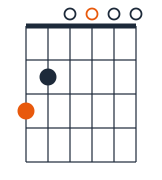
320000open position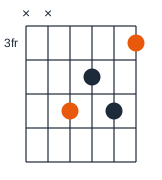
xx5453fret 3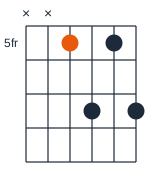
xx5757fret 5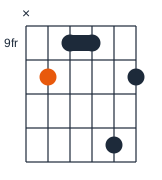
x-10-9-9-12-10fret 9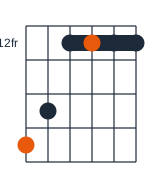
15-14-12-12-12-12fret 12On the ukulele
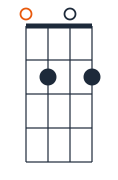
0202open position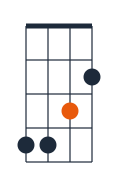
4432fret 2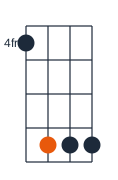
4777fret 4On the piano
On the staff
On bass and as an arpeggio
3Indications: what it is used for
Used as a tonic chord in swing, early jazz, rockabilly, western swing, bossa nova and vintage pop, often instead of the major seventh. It appears at endings, in shuffle rhythm patterns (the boogie 5–6 movement) and in big-band voicings. A sixth chord shares its notes with the minor seventh chord built on its sixth, so it can be reinterpreted in reharmonisation. Guitarists use it for comping on the tonic in swing and blues.
4Dosage: how to practise it
On guitar, learn the closed four-string shapes rooted on the fifth and sixth strings, and the shuffle pattern that alternates fifth and sixth over the root. On piano, play root-third-fifth-sixth and its inversions, especially the voicing with the sixth just below the root. Practise I6–vi7–ii7–V7 at 80–120 BPM with a swing feel. Arpeggiate the chord on bass. Five to ten minutes daily, comparing it with the major seventh chord to hear the difference.
5Warnings and common mistakes
Do not confuse it with a thirteenth chord: the 6 chord has no seventh. With the sixth in the bass it becomes a minor seventh chord, so always keep the intended root in the bass. Avoid placing the sixth directly next to the fifth at the top of a voicing if it sounds muddy; spread the voicing. Some charts write '6' meaning a 6/9 chord; check the style and melody.
6Interactions with chords, scales and keys
Inversions
- Inversion 1 · G6/B · B – D – E – G
- Inversion 2 · G6/D · D – E – G – B
- Inversion 3 · G6/E · E – G – B – D
Scales to play over G6
7Other presentations available
The same chord from every note
C6 C♯6 D6 E♭6 E6 F6 F♯6 A♭6 A6 B♭6 B6
Other chords on G
G Gm Gdim Gaug Gsus2 Gsus4 G5 Gm6 G7 Gmaj7 Gm7 Gm7♭5 Gdim7 Gm(maj7) G7sus4 Gadd9 Gm(add9) G6/9 G9 Gmaj9 Gm9 G11 Gm11 G13 G7♭9 G7♯9 G7♯5 G7♭5
Read this leaflet carefully before playing. Keep it near your instrument. Free to use, print and share for personal and educational use.