Package leaflet · Information for the musician · Chord
G Seventh Flat Five Chord (G7♭5)
Edgy, symmetrical and jazzy. A dominant seventh with a lowered fifth, containing two tritones and sounding modern and unstable.
- G7♭5
- 4 notes
- 343003
1Composition: what it contains
G – B – D♭ – F
- Symbol
- G7♭5
- Also written
- G7♭5, G7(♭5), G7-5
- Formula
- 1 3 ♭5 ♭7
| Degree | Note | Interval | Semitones |
|---|---|---|---|
| 1 | G | unison | 0 |
| 3 | B | major third | 4 |
| ♭5 | D♭ | diminished fifth | 6 |
| ♭7 | F | minor seventh | 10 |
2Appearance: diagrams and sound
On the guitar
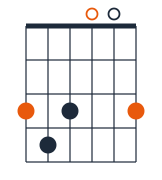
343003open position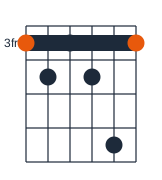
343463fret 3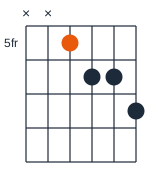
xx5667fret 5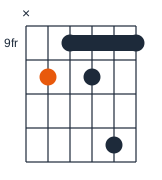
x-10-9-10-12-9fret 9On the ukulele
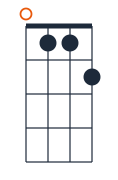
0112open position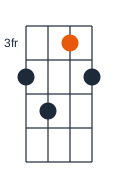
4534fret 3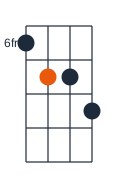
6778fret 6On the piano
On the staff
On bass and as an arpeggio
3Indications: what it is used for
Used as an altered V7 in jazz, bebop and Latin jazz, and as a dominant built on the flat second in a tritone substitution (♭II7♭5–I), where its symmetrical tritones make it identical to the 7♭5 chord a tritone away. It also appears in French augmented-sixth harmony in classical music. The whole-tone scale, Lydian dominant (as ♯11) or the altered scale fits over it, depending on the other tensions. Because its two tritones are symmetrical, it sounds equally convincing from either root.
4Dosage: how to practise it
On guitar, learn the shapes rooted on the sixth string and fifth string, and notice that moving the shape six frets gives the same notes. On piano, play 1-3-♭5-♭7 in all inversions and practise ii7–V7♭5–Imaj7 and ii7–♭II7♭5–Imaj7 at 70–120 BPM. Arpeggiate 1-3-♭5-♭7. Five minutes daily, comparing with 7 and 7♯11. Improvise over it with the whole-tone scale and then with Lydian dominant. Practise tritone substitutions in all keys, playing the ♭5 shape and the substitute chord side by side so you hear that they are the same notes.
5Warnings and common mistakes
Do not confuse 7♭5 with m7♭5: the third is major here. Do not play the natural fifth together with the flat fifth. In a context with a natural fifth in the melody, write 7♯11 rather than 7♭5. Because of its symmetry, beginners mislabel its root; check the bass. The symbol '7-5' is ambiguous and can be misread; prefer 7♭5. On piano, avoid doubling the flat fifth.
6Interactions with chords, scales and keys
Inversions
- Inversion 1 · G7♭5/B · B – D♭ – F – G
- Inversion 2 · G7♭5/D♭ · D♭ – F – G – B
- Inversion 3 · G7♭5/F · F – G – B – D♭
Scales to play over G7♭5
7Other presentations available
The same chord from every note
C7♭5 C♯7♭5 D7♭5 E♭7♭5 E7♭5 F7♭5 F♯7♭5 A♭7♭5 A7♭5 B♭7♭5 B7♭5
Other chords on G
G Gm Gdim Gaug Gsus2 Gsus4 G5 G6 Gm6 G7 Gmaj7 Gm7 Gm7♭5 Gdim7 Gm(maj7) G7sus4 Gadd9 Gm(add9) G6/9 G9 Gmaj9 Gm9 G11 Gm11 G13 G7♭9 G7♯9 G7♯5
Read this leaflet carefully before playing. Keep it near your instrument. Free to use, print and share for personal and educational use.