Package leaflet · Information for the musician · Chord
F sharp Added Ninth Chord (F♯add9)
Shimmering, open and modern. A major triad with an added ninth but no seventh, bright without jazz complexity.
- F♯add9
- 4 notes
- xx4324
1Composition: what it contains
F♯ – A♯ – C♯ – G♯
- Symbol
- F♯add9
- Also written
- F♯add9, F♯add2, F♯(add9)
- Formula
- 1 3 5 9
- Same sound as
- G♭add9
| Degree | Note | Interval | Semitones |
|---|---|---|---|
| 1 | F♯ | unison | 0 |
| 3 | A♯ | major third | 4 |
| 5 | C♯ | perfect fifth | 7 |
| 9 | G♯ | major ninth | 14 |
2Appearance: diagrams and sound
On the guitar
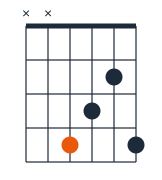
xx4324fret 2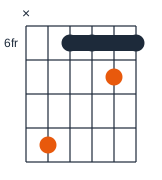
x96676fret 6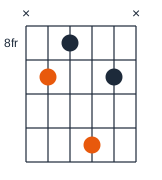
x-9-8-11-9-xfret 8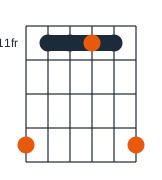
14-11-11-11-11-14fret 11On the ukulele
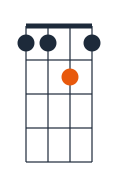
1121fret 1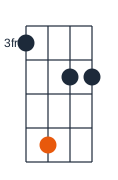
3644fret 3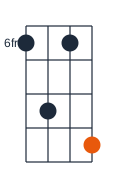
6869fret 6On the piano
On the staff
On bass and as an arpeggio
3Indications: what it is used for
Very popular in pop, rock, worship, singer-songwriter and acoustic styles as a richer version of a major chord on I, IV or V. It adds colour without changing the function of the triad. Guitarists use it in open-string voicings and arpeggiated patterns; pianists use it in ballads and pads. It can replace a plain major chord almost anywhere the melody does not hold the second degree against it. In film music it creates a hopeful, open sound.
4Dosage: how to practise it
On guitar, learn the open shapes (with the ninth on an open or fretted string) and the movable shape rooted on the fifth string; play arpeggio patterns across four strings at 70–90 BPM. On piano, play root-2-3-5 in close position and spread voicings (root-5 in the left hand, 9-3 in the right). Practise progressions like I–V–vi–IV with all chords as add9. Five minutes daily. Compare each add9 with the plain triad and with the sus2 version to train your ear to the presence of the third.
5Warnings and common mistakes
Do not confuse add9 with a ninth chord (9), which includes the flat seventh, or with sus2, which omits the third. The ninth placed directly next to the third (a major second apart) can sound muddy in low registers; voice it higher. 'Add2' usually means the same notes with the second placed within the octave. Avoid doubling the ninth. In strummed guitar parts, make sure the ninth actually sounds and is not muted by a neighbouring finger.
6Interactions with chords, scales and keys
Inversions
- Inversion 1 · F♯add9/A♯ · A♯ – C♯ – G♯ – F♯
- Inversion 2 · F♯add9/C♯ · C♯ – G♯ – F♯ – A♯
- Inversion 3 · F♯add9/G♯ · G♯ – F♯ – A♯ – C♯
Scales to play over F♯add9
7Other presentations available
The same chord from every note
Cadd9 C♯add9 Dadd9 E♭add9 Eadd9 Fadd9 Gadd9 A♭add9 Aadd9 B♭add9 Badd9
Other chords on F♯
F♯ F♯m F♯dim F♯aug F♯sus2 F♯sus4 F♯5 F♯6 F♯m6 F♯7 F♯maj7 F♯m7 F♯m7♭5 F♯dim7 F♯m(maj7) F♯7sus4 F♯m(add9) F♯6/9 F♯9 F♯maj9 F♯m9 F♯11 F♯m11 F♯13 F♯7♭9 F♯7♯9 F♯7♯5 F♯7♭5
Read this leaflet carefully before playing. Keep it near your instrument. Free to use, print and share for personal and educational use.