Package leaflet · Information for the musician · Chord
F sharp Seventh Sharp Five Chord (F♯7♯5)
Restless, rising and bluesy. A dominant seventh with an augmented fifth that pushes upward to the next chord.
- F♯7♯5
- 4 notes
- 210330
1Composition: what it contains
F♯ – A♯ – C𝄪 – E
- Symbol
- F♯7♯5
- Also written
- F♯7♯5, F♯aug7, F♯+7, F♯7+, F♯7(♯5)
- Formula
- 1 3 ♯5 ♭7
- Same sound as
- G♭7♯5
| Degree | Note | Interval | Semitones |
|---|---|---|---|
| 1 | F♯ | unison | 0 |
| 3 | A♯ | major third | 4 |
| ♯5 | C𝄪 | augmented fifth | 8 |
| ♭7 | E | minor seventh | 10 |
2Appearance: diagrams and sound
On the guitar
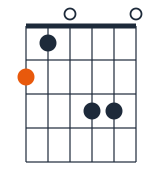
210330open position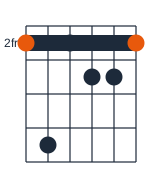
252332fret 2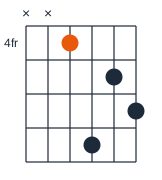
xx4756fret 4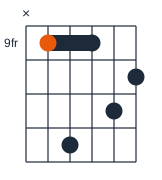
x-9-12-9-11-10fret 9On the ukulele
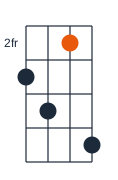
3425fret 2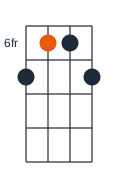
7667fret 6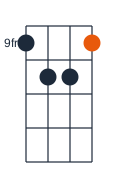
9-10-10-9fret 9On the piano
On the staff
On bass and as an arpeggio
3Indications: what it is used for
A V7 chord with a raised fifth leading to the third of the I chord: common in jazz, blues, swing, gospel, ragtime and old pop. It acts as a dominant with extra pull, especially in major keys (the raised fifth moves up to the third of the tonic). The whole-tone scale fits over it, and the altered scale works when combined with ♭9 or ♯9. It also appears as a turnaround chord in blues (V7♯5 back to I7).
4Dosage: how to practise it
On guitar, learn the shape rooted on the sixth string and the shape rooted on the fifth string, and practise resolving the raised fifth up to the target chord's third. On piano, play 1-3-♯5-♭7 in all inversions and practise V7♯5–I and ii7–V7♯5–Imaj7 at 70–110 BPM. Improvise with the whole-tone scale over the chord. Five minutes daily. On bass, outline root, third and the raised fifth, and lead the raised fifth upward. Compare the chord with plain dominant sevenths and listen for the rising chromatic voice.
5Warnings and common mistakes
Do not play the natural fifth together with the raised fifth: they clash. Do not confuse 7♯5 with 7♭13: they share the same note but the ♭13 implies the natural fifth may be present, and the scale choice differs. The symbol '+7' is sometimes confused with 'maj7'; read carefully. Do not confuse with maj7♯5, which has a major seventh. On guitar, check that no open string sounds the natural fifth.
6Interactions with chords, scales and keys
Inversions
- Inversion 1 · F♯7♯5/A♯ · A♯ – C𝄪 – E – F♯
- Inversion 2 · F♯7♯5/C𝄪 · C𝄪 – E – F♯ – A♯
- Inversion 3 · F♯7♯5/E · E – F♯ – A♯ – C𝄪
Scales to play over F♯7♯5
7Other presentations available
The same chord from every note
C7♯5 C♯7♯5 D7♯5 E♭7♯5 E7♯5 F7♯5 G7♯5 A♭7♯5 A7♯5 B♭7♯5 B7♯5
Other chords on F♯
F♯ F♯m F♯dim F♯aug F♯sus2 F♯sus4 F♯5 F♯6 F♯m6 F♯7 F♯maj7 F♯m7 F♯m7♭5 F♯dim7 F♯m(maj7) F♯7sus4 F♯add9 F♯m(add9) F♯6/9 F♯9 F♯maj9 F♯m9 F♯11 F♯m11 F♯13 F♯7♭9 F♯7♯9 F♯7♭5
Read this leaflet carefully before playing. Keep it near your instrument. Free to use, print and share for personal and educational use.