Package leaflet · Information for the musician · Chord
F sharp Dominant Seventh Chord (F♯7)
Bluesy, tense and driving. A major triad with a flat seventh: the tritone between the third and seventh wants to resolve.
- F♯7
- 4 notes
- 242320
1Composition: what it contains
F♯ – A♯ – C♯ – E
- Symbol
- F♯7
- Also written
- F♯7, F♯dom7
- Formula
- 1 3 5 ♭7
- Same sound as
- G♭7
| Degree | Note | Interval | Semitones |
|---|---|---|---|
| 1 | F♯ | unison | 0 |
| 3 | A♯ | major third | 4 |
| 5 | C♯ | perfect fifth | 7 |
| ♭7 | E | minor seventh | 10 |
2Appearance: diagrams and sound
On the guitar
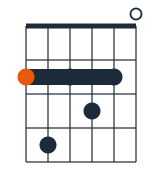
242320open position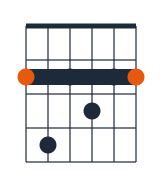
242322fret 2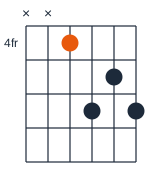
xx4656fret 4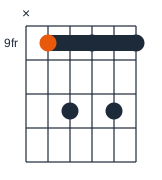
x-9-11-9-11-9fret 9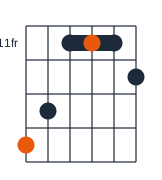
14-13-11-11-11-12fret 11On the ukulele
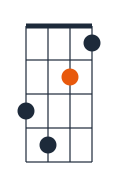
3421fret 1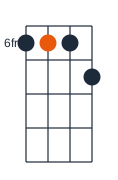
6667fret 6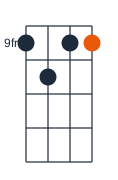
9-10-9-9fret 9On the piano
On the staff
On bass and as an arpeggio
3Indications: what it is used for
The V7 chord of a major or minor key, resolving to I or i: the most important cadence in tonal music. In blues, every chord (I7, IV7, V7) is a dominant seventh, used as a stable colour rather than tension. Secondary dominants (V7/ii, V7/V...) create chromatic movement, and tritone substitution replaces a V7 with the dominant seventh a tritone away. It is fundamental in jazz, blues, funk, rock and roll, gospel and classical music.
4Dosage: how to practise it
On guitar, learn the open shapes, the barre shapes rooted on the sixth and fifth strings, and shell voicings (root, third, seventh). On piano, play the chord in all inversions, then practise V7–I with the third resolving up a half step and the seventh resolving down. Play a twelve-bar blues with dominant sevenths at 80–120 BPM with a shuffle feel. Arpeggiate 1-3-5-♭7 on bass. Practise ii–V–I loops for ten minutes daily.
5Warnings and common mistakes
The symbol '7' alone means a dominant seventh (flat seventh), not a major seventh: this is the most common chord-symbol mistake. Do not confuse it with maj7 or m7. In voicings, omit the fifth rather than the third or seventh, which define the chord. The tritone between third and seventh should resolve properly in classical writing; parallel dominants are fine in blues. Avoid playing the root note of the next chord on top in a way that hides the resolution.
6Interactions with chords, scales and keys
Inversions
- Inversion 1 · F♯7/A♯ · A♯ – C♯ – E – F♯
- Inversion 2 · F♯7/C♯ · C♯ – E – F♯ – A♯
- Inversion 3 · F♯7/E · E – F♯ – A♯ – C♯
Scales to play over F♯7
- F sharp Mixolydian Mode
- F sharp Half-Whole Diminished Scale
- F sharp Phrygian Dominant Scale
- F sharp Lydian Dominant Scale
- F sharp Bebop Dominant Scale
Where it appears (keys and Roman numerals)
7Other presentations available
The same chord from every note
C7 C♯7 D7 E♭7 E7 F7 G7 A♭7 A7 B♭7 B7
Other chords on F♯
F♯ F♯m F♯dim F♯aug F♯sus2 F♯sus4 F♯5 F♯6 F♯m6 F♯maj7 F♯m7 F♯m7♭5 F♯dim7 F♯m(maj7) F♯7sus4 F♯add9 F♯m(add9) F♯6/9 F♯9 F♯maj9 F♯m9 F♯11 F♯m11 F♯13 F♯7♭9 F♯7♯9 F♯7♯5 F♯7♭5
Read this leaflet carefully before playing. Keep it near your instrument. Free to use, print and share for personal and educational use.