Package leaflet · Information for the musician · Chord
E flat Seventh Suspended Fourth Chord (E♭7sus4)
Open, floating and modern. A dominant seventh with the fourth replacing the third: tension without the tritone.
- E♭7sus4
- 4 notes
- xx1324
1Composition: what it contains
E♭ – A♭ – B♭ – D♭
- Symbol
- E♭7sus4
- Also written
- E♭7sus4, E♭7sus, E♭sus7
- Formula
- 1 4 5 ♭7
- Same sound as
- D♯7sus4
| Degree | Note | Interval | Semitones |
|---|---|---|---|
| 1 | E♭ | unison | 0 |
| 4 | A♭ | perfect fourth | 5 |
| 5 | B♭ | perfect fifth | 7 |
| ♭7 | D♭ | minor seventh | 10 |
2Appearance: diagrams and sound
On the guitar
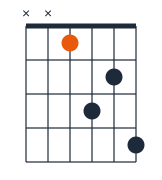
xx1324fret 1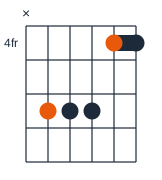
x66644fret 4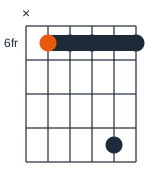
x66696fret 6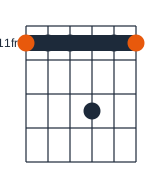
11-11-11-13-11-11fret 11On the ukulele
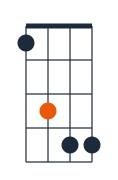
1344fret 1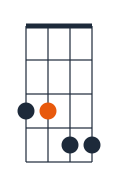
3344fret 3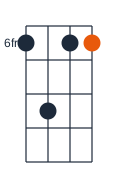
6866fret 6On the piano
On the staff
On bass and as an arpeggio
3Indications: what it is used for
Used as a V chord before the V7 (V7sus4–V7–I), as a modal dominant in jazz, funk, fusion and gospel, and as a static vamp chord in modal jazz. It is often equivalent to a ii7 chord over the V bass (ii/V) or to a 9sus4 chord. Classical music uses it as a suspension resolving to V7. It suits pop and rock as a softer alternative to the dominant seventh, and Mixolydian is the typical scale over it.
4Dosage: how to practise it
On guitar, learn the barre shapes rooted on the sixth and fifth strings and practise resolving the fourth to the third (7sus4–7). On piano, play root-4-5-♭7 in all inversions, and practise the 'slash' voicing of a ii7 chord over the V root. Practise V7sus4–V7–I in all keys at 70–110 BPM. Improvise over a 7sus4 vamp with Mixolydian for five minutes daily. On bass, alternate root and fifth while the chord rings, then add the flat seventh in fills.
5Warnings and common mistakes
Do not add the major third to a 7sus4 voicing unless you want an eleventh chord sound: the 'sus' means no third. Do not confuse it with an eleventh chord, which also contains the ninth. On guitar, check that the fourth is fretted and the third muted. In classical writing, the fourth should resolve down by step to the third. The symbol 'sus7' is ambiguous; prefer 7sus4.
6Interactions with chords, scales and keys
Inversions
- Inversion 1 · E♭7sus4/A♭ · A♭ – B♭ – D♭ – E♭
- Inversion 2 · E♭7sus4/B♭ · B♭ – D♭ – E♭ – A♭
- Inversion 3 · E♭7sus4/D♭ · D♭ – E♭ – A♭ – B♭
Scales to play over E♭7sus4
7Other presentations available
The same chord from every note
C7sus4 C♯7sus4 D7sus4 E7sus4 F7sus4 F♯7sus4 G7sus4 A♭7sus4 A7sus4 B♭7sus4 B7sus4
Other chords on E♭
E♭ E♭m E♭dim E♭aug E♭sus2 E♭sus4 E♭5 E♭6 E♭m6 E♭7 E♭maj7 E♭m7 E♭m7♭5 E♭dim7 E♭m(maj7) E♭add9 E♭m(add9) E♭6/9 E♭9 E♭maj9 E♭m9 E♭11 E♭m11 E♭13 E♭7♭9 E♭7♯9 E♭7♯5 E♭7♭5
Read this leaflet carefully before playing. Keep it near your instrument. Free to use, print and share for personal and educational use.