Package leaflet · Information for the musician · Chord
E flat Major Seventh Chord (E♭maj7)
Lush, soft and sophisticated. A major triad with a major seventh, a half step below the octave, giving a warm, slightly bittersweet glow.
- E♭maj7
- 4 notes
- xx1033
1Composition: what it contains
E♭ – G – B♭ – D
- Symbol
- E♭maj7
- Also written
- E♭maj7, E♭M7, E♭Δ7, E♭Δ, E♭ma7
- Formula
- 1 3 5 7
- Same sound as
- D♯maj7
| Degree | Note | Interval | Semitones |
|---|---|---|---|
| 1 | E♭ | unison | 0 |
| 3 | G | major third | 4 |
| 5 | B♭ | perfect fifth | 7 |
| 7 | D | major seventh | 11 |
2Appearance: diagrams and sound
On the guitar
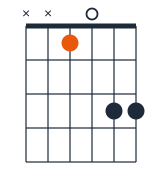
xx1033open position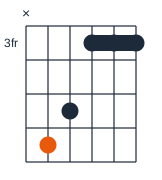
x65333fret 3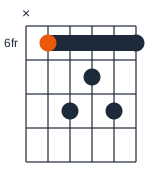
x68786fret 6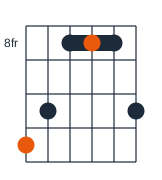
11-10-8-8-8-10fret 8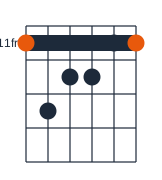
11-13-12-12-11-11fret 11On the ukulele
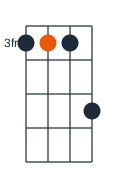
3335fret 3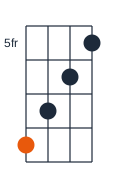
8765fret 5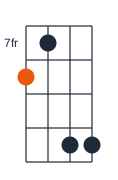
8-7-10-10fret 7On the piano
On the staff
On bass and as an arpeggio
3Indications: what it is used for
The Imaj7 and IVmaj7 chords of a major key, typical in jazz, bossa nova, soul, neo-soul, R&B, city pop, lo-fi and ballads. It is the tonic of a major ii–V–I and is often paired with the sixth chord as an alternative. In minor keys it appears as IIImaj7 and VImaj7. It can be extended to maj9 or maj7♯11 (for the Lydian sound), and a major seventh can substitute a plain major triad to soften a progression.
4Dosage: how to practise it
On guitar, learn the shapes rooted on the sixth string (with the fifth string muted), on the fifth string and drop-2 voicings on the top four strings. On piano, play root-3-5-7 in all inversions and the left-hand shell 1-7 or 3-7 with the melody above. Practise ii7–V7–Imaj7 at 80–140 BPM in all keys around the circle of fifths. Arpeggiate the chord in two octaves. Ten minutes daily. Listen for the half step between the seventh and the octave and keep it soft and balanced.
5Warnings and common mistakes
Do not confuse maj7 with the dominant seventh '7': the major seventh is a half step below the octave, the flat seventh a whole step. Avoid voicing the root a minor ninth above the major seventh (seventh low, root on top), which sounds harsh. If the melody holds the root or the fourth, a major seventh may clash; consider a 6 chord. The triangle (Δ) alone also means major seventh.
6Interactions with chords, scales and keys
Inversions
- Inversion 1 · E♭maj7/G · G – B♭ – D – E♭
- Inversion 2 · E♭maj7/B♭ · B♭ – D – E♭ – G
- Inversion 3 · E♭maj7/D · D – E♭ – G – B♭
Scales to play over E♭maj7
Where it appears (keys and Roman numerals)
7Other presentations available
The same chord from every note
Cmaj7 C♯maj7 Dmaj7 Emaj7 Fmaj7 F♯maj7 Gmaj7 A♭maj7 Amaj7 B♭maj7 Bmaj7
Other chords on E♭
E♭ E♭m E♭dim E♭aug E♭sus2 E♭sus4 E♭5 E♭6 E♭m6 E♭7 E♭m7 E♭m7♭5 E♭dim7 E♭m(maj7) E♭7sus4 E♭add9 E♭m(add9) E♭6/9 E♭9 E♭maj9 E♭m9 E♭11 E♭m11 E♭13 E♭7♭9 E♭7♯9 E♭7♯5 E♭7♭5
Read this leaflet carefully before playing. Keep it near your instrument. Free to use, print and share for personal and educational use.