Package leaflet · Information for the musician · Chord
E flat Suspended Fourth Chord (E♭sus4)
Tense but not dissonant, waiting to resolve. The fourth replaces the third and pulls down toward it.
- E♭sus4
- 3 notes
- xx1344
1Composition: what it contains
E♭ – A♭ – B♭
- Symbol
- E♭sus4
- Also written
- E♭sus4, E♭sus
- Formula
- 1 4 5
- Same sound as
- D♯sus4
| Degree | Note | Interval | Semitones |
|---|---|---|---|
| 1 | E♭ | unison | 0 |
| 4 | A♭ | perfect fourth | 5 |
| 5 | B♭ | perfect fifth | 7 |
2Appearance: diagrams and sound
On the guitar
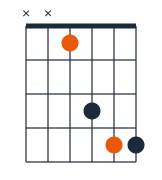
xx1344fret 1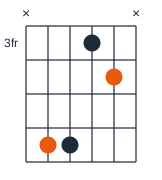
x6634xfret 3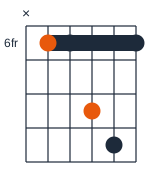
x66896fret 6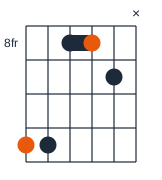
11-11-8-8-9-xfret 8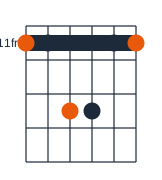
11-11-13-13-11-11fret 11On the ukulele

1341fret 1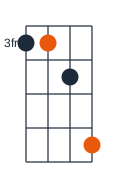
3346fret 3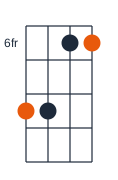
8866fret 6On the piano
On the staff
On bass and as an arpeggio
3Indications: what it is used for
In classical harmony it is a suspension: the fourth is held over from the previous chord and then resolves down to the third (4–3 suspension), very common on the V chord at cadences (Vsus4–V–I). In pop, rock and folk it is used as a colour chord and in strummed patterns (major–sus4–major). In gospel and jazz it appears as a 'sus' dominant, often extended to 7sus4 or 9sus4. It suits anthems, worship songs and open-string guitar riffs.
4Dosage: how to practise it
On guitar, practise the open shapes and hammer the fourth on and off while strumming; then learn barre shapes rooted on the fifth and sixth strings. On piano, play root–fourth–fifth and resolve the fourth down to the third, both hands, at 60 BPM. Practise the cadence IV–Vsus4–V–I in several keys. Spend five minutes a day writing short chord loops using sus4 resolutions to train both hands and ear. On bass, outline root, fourth and fifth, then move the fourth to the third when the chord resolves.
5Warnings and common mistakes
Do not play the third together with the fourth unless you want a dense add11 sound: the 'sus' chord means no third. 'Sus' alone usually means sus4. Do not confuse it with an eleventh chord, which also contains a seventh and often a ninth. On guitar, check that your finger is not muting the fourth when it should ring. A sus4 does not have to resolve in modern styles, but in classical writing it should.
6Interactions with chords, scales and keys
Inversions
- Inversion 1 · E♭sus4/A♭ · A♭ – B♭ – E♭
- Inversion 2 · E♭sus4/B♭ · B♭ – E♭ – A♭
Scales to play over E♭sus4
7Other presentations available
The same chord from every note
Csus4 C♯sus4 Dsus4 Esus4 Fsus4 F♯sus4 Gsus4 A♭sus4 Asus4 B♭sus4 Bsus4
Other chords on E♭
E♭ E♭m E♭dim E♭aug E♭sus2 E♭5 E♭6 E♭m6 E♭7 E♭maj7 E♭m7 E♭m7♭5 E♭dim7 E♭m(maj7) E♭7sus4 E♭add9 E♭m(add9) E♭6/9 E♭9 E♭maj9 E♭m9 E♭11 E♭m11 E♭13 E♭7♭9 E♭7♯9 E♭7♯5 E♭7♭5
Read this leaflet carefully before playing. Keep it near your instrument. Free to use, print and share for personal and educational use.