Package leaflet · Information for the musician · Chord
E flat Diminished Seventh Chord (E♭dim7)
Dramatic, suspenseful and symmetrical. Stacked minor thirds create a chord full of tension, famous for shocks in film and opera.
- E♭dim7
- 4 notes
- xx1212
1Composition: what it contains
E♭ – G♭ – B𝄫 – D𝄫
- Symbol
- E♭dim7
- Also written
- E♭dim7, E♭°7, E♭o7
- Formula
- 1 ♭3 ♭5 ♭♭7
- Same sound as
- D♯dim7
| Degree | Note | Interval | Semitones |
|---|---|---|---|
| 1 | E♭ | unison | 0 |
| ♭3 | G♭ | minor third | 3 |
| ♭5 | B𝄫 | diminished fifth | 6 |
| ♭♭7 | D𝄫 | diminished seventh | 9 |
2Appearance: diagrams and sound
On the guitar
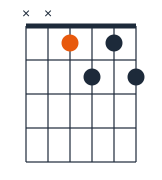
xx1212fret 1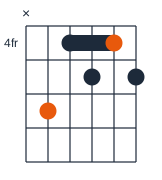
x64545fret 4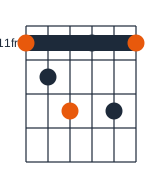
11-12-13-11-13-11fret 11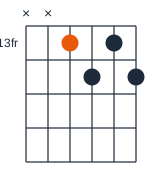
x-x-13-14-13-14fret 13On the ukulele
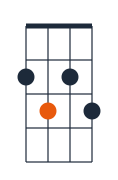
2323fret 2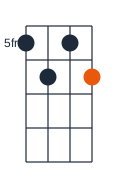
5656fret 5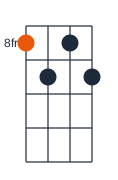
8989fret 8On the piano
On the staff
On bass and as an arpeggio
3Indications: what it is used for
The vii°7 chord of harmonic minor, resolving to i (or to I in major as a borrowed chord). It acts like a V7♭9 without its root, so it is a dominant substitute. It is widely used as a passing chord between diatonic chords (I–♯I°7–ii, IV–♯IV°7–I/5), in classical music, ragtime, gospel, gypsy jazz and film scores. Because it divides the octave into four equal minor thirds, any of its four notes can be the root, and it can resolve to four different keys.
4Dosage: how to practise it
On guitar, learn one four-string shape and move it up three frets: it is the same chord in a new inversion. On piano, play it in all inversions and notice the identical spacing. Practise resolutions from vii°7 to i in minor keys, letting each voice move by step, at 60–90 BPM. Practise the passing progression I–♯I°7–ii7–V7. There are only three distinct dim7 chords; learn all three in five minutes a day.
5Warnings and common mistakes
Do not confuse dim7 with m7♭5: the seventh here is diminished (enharmonic to a major sixth). Many charts write just 'dim' or '°' for this four-note chord; check the context. Correct spelling uses stacked minor thirds with a double flat on the seventh, which can look strange but matters for reading. Overuse quickly sounds melodramatic. On guitar, avoid letting open strings ring that do not belong.
6Interactions with chords, scales and keys
Inversions
- Inversion 1 · E♭dim7/G♭ · G♭ – B𝄫 – D𝄫 – E♭
- Inversion 2 · E♭dim7/B𝄫 · B𝄫 – D𝄫 – E♭ – G♭
- Inversion 3 · E♭dim7/D𝄫 · D𝄫 – E♭ – G♭ – B𝄫
Scales to play over E♭dim7
7Other presentations available
The same chord from every note
Cdim7 C♯dim7 Ddim7 Edim7 Fdim7 F♯dim7 Gdim7 A♭dim7 Adim7 B♭dim7 Bdim7
Other chords on E♭
E♭ E♭m E♭dim E♭aug E♭sus2 E♭sus4 E♭5 E♭6 E♭m6 E♭7 E♭maj7 E♭m7 E♭m7♭5 E♭m(maj7) E♭7sus4 E♭add9 E♭m(add9) E♭6/9 E♭9 E♭maj9 E♭m9 E♭11 E♭m11 E♭13 E♭7♭9 E♭7♯9 E♭7♯5 E♭7♭5
Read this leaflet carefully before playing. Keep it near your instrument. Free to use, print and share for personal and educational use.