Package leaflet · Information for the musician · Chord
B Minor Chord (Bm)
Soft, sad and introspective. Root, minor third and perfect fifth: the darker twin of the major triad.
- Bm
- 3 notes
- x20402
1Composition: what it contains
B – D – F♯
- Symbol
- Bm
- Also written
- Bm, Bmin, B-
- Formula
- 1 ♭3 5
| Degree | Note | Interval | Semitones |
|---|---|---|---|
| 1 | B | unison | 0 |
| ♭3 | D | minor third | 3 |
| 5 | F♯ | perfect fifth | 7 |
2Appearance: diagrams and sound
On the guitar
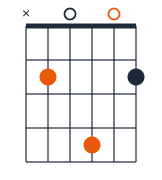
x20402open position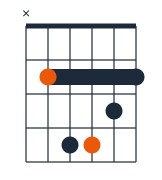
x24432fret 2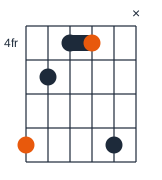
75447xfret 4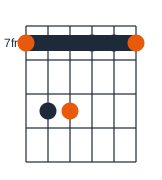
799777fret 7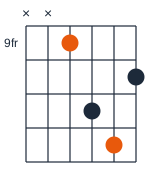
x-x-9-11-12-10fret 9On the ukulele
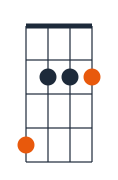
4222fret 2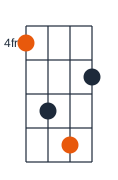
4675fret 4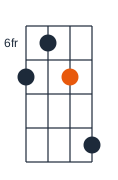
7679fret 6On the piano
On the staff
On bass and as an arpeggio
3Indications: what it is used for
The ii, iii and vi chords of a major key and the i, iv and (natural) v chords of a minor key are minor triads. It anchors ballads, rock anthems, folk and film music; progressions like vi–IV–I–V, i–VI–III–VII and i–iv–v are built on it. The relative minor (vi) often substitutes for the tonic (I), and minor chords can be extended to m7, m9 or m6 depending on style. In blues-rock, a minor chord on the tonic often supports minor pentatonic soloing.
4Dosage: how to practise it
On guitar, learn the open minor shapes, the barre shapes rooted on the sixth and fifth strings, and three-string triads in all inversions. On piano, play the triad in root position and both inversions, hands separately and together, at 60–80 BPM. Then practise switching between a major chord and its parallel minor to hear the third change. Arpeggiate the chord on bass (1-♭3-5-8). Five minutes daily of i–iv–v and vi–IV–I–V loops will cement it.
5Warnings and common mistakes
The minor third is the only difference from the major chord: make sure your fingering lowers exactly that note. A lowercase 'm' means minor, while 'M' or 'maj' means major; misreading them is a common sight-reading error. A minus sign (-) is also minor. Do not confuse 'm' with 'dim': the diminished chord also lowers the fifth. In dense voicings, keep the minor third clearly audible or the chord becomes ambiguous.
6Interactions with chords, scales and keys
Inversions
- Inversion 1 · Bm/D · D – F♯ – B
- Inversion 2 · Bm/F♯ · F♯ – B – D
Scales to play over Bm
- B Natural Minor Scale
- B Harmonic Minor Scale
- B Melodic Minor Scale
- B Dorian Mode
- B Phrygian Mode
- B Minor Pentatonic Scale
- B Blues Scale
- B Major Blues Scale
- B Half-Whole Diminished Scale
- B Hungarian Minor Scale
Where it appears (keys and Roman numerals)
7Other presentations available
The same chord from every note
Cm C♯m Dm E♭m Em Fm F♯m Gm A♭m Am B♭m
Other chords on B
B Bdim Baug Bsus2 Bsus4 B5 B6 Bm6 B7 Bmaj7 Bm7 Bm7♭5 Bdim7 Bm(maj7) B7sus4 Badd9 Bm(add9) B6/9 B9 Bmaj9 Bm9 B11 Bm11 B13 B7♭9 B7♯9 B7♯5 B7♭5
Read this leaflet carefully before playing. Keep it near your instrument. Free to use, print and share for personal and educational use.