Package leaflet · Information for the musician · Chord
A flat Minor Seventh Chord (A♭m7)
Mellow, smooth and soulful. A minor triad with a flat seventh: softer than a plain minor chord and less tense than a dominant.
- A♭m7
- 4 notes
- 421102
1Composition: what it contains
A♭ – C♭ – E♭ – G♭
- Symbol
- A♭m7
- Also written
- A♭m7, A♭min7, A♭-7, A♭mi7
- Formula
- 1 ♭3 5 ♭7
- Same sound as
- G♯m7
| Degree | Note | Interval | Semitones |
|---|---|---|---|
| 1 | A♭ | unison | 0 |
| ♭3 | C♭ | minor third | 3 |
| 5 | E♭ | perfect fifth | 7 |
| ♭7 | G♭ | minor seventh | 10 |
2Appearance: diagrams and sound
On the guitar
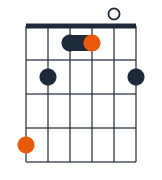
421102open position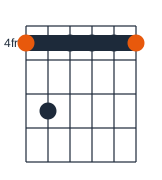
464444fret 4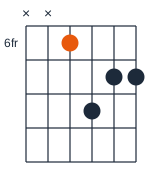
xx6877fret 6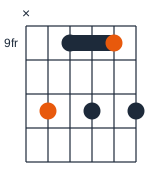
x-11-9-11-9-11fret 9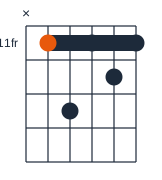
x-11-13-11-12-11fret 11On the ukulele
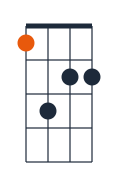
1322fret 1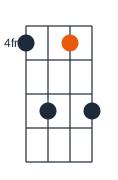
4646fret 4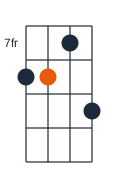
8879fret 7On the piano
On the staff
On bass and as an arpeggio
3Indications: what it is used for
The ii7, iii7 and vi7 chords of a major key and the i7 and iv7 chords of a minor key (in natural minor or Dorian context). It is the ii in the ii–V–I, the main chord in funk, soul, R&B and modal jazz vamps, and a common colour in pop and lo-fi. Dorian is the typical scale over it. It can substitute for a IV chord (ii7 for IV) and is often extended to m9 or m11.
4Dosage: how to practise it
On guitar, learn barre shapes rooted on the sixth and fifth strings, drop-2 voicings on the top four strings, and shells (root, ♭3, ♭7). On piano, play it in all inversions and in rootless voicings (♭3-5-♭7-9). Practise ii7–V7–Imaj7 progressions at 80–140 BPM in all keys. Play funk vamps on one m7 chord with sixteenth-note strumming. Arpeggiate 1-♭3-5-♭7 on bass. Ten minutes a day. Then practise moving smoothly from m7 shapes to the dominant chord a fourth higher, keeping common tones.
5Warnings and common mistakes
Do not confuse m7 with mMaj7 (major seventh) or with m7♭5 (flattened fifth). The minor seventh chord shares its notes with the major sixth chord built on its third, so the bass decides the name. On guitar, beginners often play a major third by mistake when moving barre shapes. In close voicings, avoid the root doubled next to the flat seventh where it sounds thick.
6Interactions with chords, scales and keys
Inversions
- Inversion 1 · A♭m7/C♭ · C♭ – E♭ – G♭ – A♭
- Inversion 2 · A♭m7/E♭ · E♭ – G♭ – A♭ – C♭
- Inversion 3 · A♭m7/G♭ · G♭ – A♭ – C♭ – E♭
Scales to play over A♭m7
- G sharp Natural Minor Scale
- G sharp Dorian Mode
- G sharp Phrygian Mode
- G sharp Minor Pentatonic Scale
- G sharp Blues Scale
- A flat Half-Whole Diminished Scale
Where it appears (keys and Roman numerals)
7Other presentations available
The same chord from every note
Cm7 C♯m7 Dm7 E♭m7 Em7 Fm7 F♯m7 Gm7 Am7 B♭m7 Bm7
Other chords on A♭
A♭ A♭m A♭dim A♭aug A♭sus2 A♭sus4 A♭5 A♭6 A♭m6 A♭7 A♭maj7 A♭m7♭5 A♭dim7 A♭m(maj7) A♭7sus4 A♭add9 A♭m(add9) A♭6/9 A♭9 A♭maj9 A♭m9 A♭11 A♭m11 A♭13 A♭7♭9 A♭7♯9 A♭7♯5 A♭7♭5
Read this leaflet carefully before playing. Keep it near your instrument. Free to use, print and share for personal and educational use.