Package leaflet · Information for the musician · Chord
A flat Suspended Second Chord (A♭sus2)
Open, airy and ambiguous. The third is replaced by the second, so the chord is neither major nor minor.
- A♭sus2
- 3 notes
- 411144
1Composition: what it contains
A♭ – B♭ – E♭
- Symbol
- A♭sus2
- Also written
- A♭sus2, A♭2
- Formula
- 1 2 5
- Same sound as
- G♯sus2
| Degree | Note | Interval | Semitones |
|---|---|---|---|
| 1 | A♭ | unison | 0 |
| 2 | B♭ | major second | 2 |
| 5 | E♭ | perfect fifth | 7 |
2Appearance: diagrams and sound
On the guitar
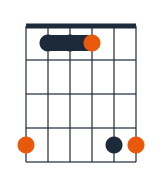
411144fret 1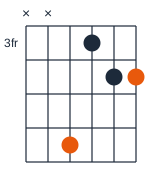
xx6344fret 3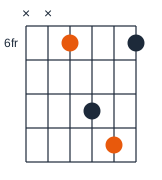
xx6896fret 6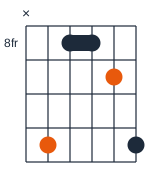
x-11-8-8-9-11fret 8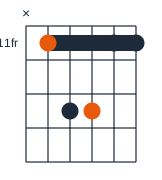
x-11-13-13-11-11fret 11On the ukulele
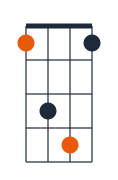
1341fret 1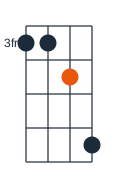
3346fret 3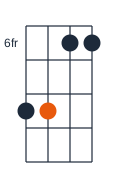
8866fret 6On the piano
On the staff
On bass and as an arpeggio
3Indications: what it is used for
Very common in pop, rock, worship music, folk and ambient, often as a colour on the I, IV or V chord or as a decorative movement from the major chord (major–sus2–major). It fits modal music where you do not want to commit to a major or minor third. Because it consists of root, second and fifth, it is also an inversion of a sus4 chord built on the fifth. In jazz it is used as a quartal, open-sounding voicing.
4Dosage: how to practise it
On guitar, learn the open sus2 shapes and practise alternating them with the major and minor shapes on the same root, then use barre shapes with the second on top. On piano, play root–second–fifth and alternate with the major and minor triad, hands separately at 70 BPM. Then try progressions where every chord is sus2 to hear the floating effect. Five minutes daily of 'hammer-on decorations' from sus2 to major on guitar builds a useful songwriting habit.
5Warnings and common mistakes
Do not confuse sus2 with add9: add9 keeps the third and adds the ninth, while sus2 removes the third entirely. A sus2 chord is also often written as just '2' on some charts. Since sus2 and sus4 can share the same notes (an inversion relationship), make sure the bass note gives the right root. The second does not need to resolve, unlike the classical sus4, but avoid adding a third on top by accident.
6Interactions with chords, scales and keys
Inversions
- Inversion 1 · A♭sus2/B♭ · B♭ – E♭ – A♭
- Inversion 2 · A♭sus2/E♭ · E♭ – A♭ – B♭
Scales to play over A♭sus2
7Other presentations available
The same chord from every note
Csus2 C♯sus2 Dsus2 E♭sus2 Esus2 Fsus2 F♯sus2 Gsus2 Asus2 B♭sus2 Bsus2
Other chords on A♭
A♭ A♭m A♭dim A♭aug A♭sus4 A♭5 A♭6 A♭m6 A♭7 A♭maj7 A♭m7 A♭m7♭5 A♭dim7 A♭m(maj7) A♭7sus4 A♭add9 A♭m(add9) A♭6/9 A♭9 A♭maj9 A♭m9 A♭11 A♭m11 A♭13 A♭7♭9 A♭7♯9 A♭7♯5 A♭7♭5
Read this leaflet carefully before playing. Keep it near your instrument. Free to use, print and share for personal and educational use.