Lessons · Intermediate
The CAGED System for Guitar: Chords, Arpeggios, Scales
Five familiar open-chord shapes that unlock the entire guitar neck for chords, arpeggios and scales.
What is the CAGED system?
The CAGED system is a way of organizing the guitar neck using the five open major chords you probably already know: C, A, G, E and D. Each of these shapes can be moved up the neck (with your index finger or a barre replacing the nut) to play any major chord. Put the five shapes for one chord side by side and they cover the entire fretboard, overlapping like links in a chain.
CAGED is not a set of rules; it is a map. It shows you where the root, 3rd and 5th of a chord are in every area of the neck, and that map is the key to finding chords, arpeggios and scales anywhere.
The five open shapes
Each shape has its root on a particular string. Knowing where the roots are is what makes the shapes movable.
| Shape | Open chord | Fingering (6th → 1st string) | Root strings |
|---|---|---|---|
| C | C major | x 3 2 0 1 0 | 5th, 2nd |
| A | A major | x 0 2 2 2 0 | 5th, 3rd |
| G | G major | 3 2 0 0 0 3 | 6th, 3rd, 1st |
| E | E major | 0 2 2 1 0 0 | 6th, 4th, 1st |
| D | D major | x x 0 2 3 2 | 4th, 2nd |
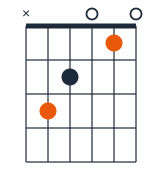
C – E – G
The E and A shapes are the familiar barre chords. The C, G and D shapes are harder to play as full chords higher up the neck, but they are extremely useful as partial chords (three or four strings) and as frameworks for arpeggios and scales.
How the shapes connect along the neck
Here is the key idea: for any chord, the shapes always follow the order C → A → G → E → D, then back to C, moving up the neck. Each shape shares at least one root note with the next one.
Here are the five shapes for C major (notes C, E, G), from the open position up to the 12th fret:
| Shape | Position | Fingering (6th → 1st) | Root(s) |
|---|---|---|---|
| C shape | open | x 3 2 0 1 0 | 5th string fret 3, 2nd string fret 1 |
| A shape | barre at fret 3 | x 3 5 5 5 3 | 5th string fret 3, 3rd string fret 5 |
| G shape | frets 5–8 | 8 7 5 5 5 8 | 6th string fret 8, 3rd string fret 5, 1st string fret 8 |
| E shape | barre at fret 8 | 8 10 10 9 8 8 | 6th string fret 8, 4th string fret 10, 1st string fret 8 |
| D shape | frets 10–13 | x x 10 12 13 12 | 4th string fret 10, 2nd string fret 13 |
| C shape | frets 12–15 | x 15 14 12 13 12 | 5th string fret 15, 2nd string fret 13 |
Notice how the shapes overlap: the A shape and the open C shape share the root on the 5th string, fret 3; the A shape and the G shape share the C on the 3rd string, fret 5; the G and E shapes share the C on the 6th string, fret 8; and so on.
Starting from any chord
The cycle can start on any letter, depending on the chord. For G major the open G is the G shape, so the order continues E → D → C → A:
| Shape | Fingering for G major |
|---|---|
| G shape | 3 2 0 0 0 3 (open) |
| E shape | 3 5 5 4 3 3 |
| D shape | x x 5 7 8 7 |
| C shape | x 10 9 7 8 7 |
| A shape | x 10 12 12 12 10 |
The open E chord starts the cycle at E → D → C → A → G, and so on. Learn to find the root on the 6th, 5th and 4th strings (see guitar fretboard notes) and you can place all five shapes for any chord.
CAGED for chords
Full five- or six-string shapes are only the beginning. In real playing you mostly use fragments:
- the top three or four strings of each shape give you small triad voicings for rhythm parts and for playing alongside another guitarist;
- adding the b7 (one whole step below a root) to a shape turns it into a dominant 7th chord;
- lowering the 3rd by one fret turns any major shape into a minor shape (C shape → Cm shape, A shape → Am shape, E shape → Em shape, and so on). The minor shapes follow the same order along the neck.
For example, the E shape at fret 8 (C major) with the 4th string lowered from fret 10 to fret 8 becomes C7: 8 10 8 9 8 8.
CAGED for arpeggios
An arpeggio is a chord played one note at a time. Each CAGED shape contains an arpeggio pattern: play only the roots, 3rds and 5ths in that area of the neck, one after the other. Here is the C major arpeggio based on the E shape at fret 8:
And the same arpeggio in the A shape at fret 3:
Practise each arpeggio slowly, saying "root, 3rd, 5th" as you play. These patterns make your solos follow the chords instead of just running up and down scales.
CAGED for scales
Each chord shape sits inside a scale pattern. If you surround the notes of a shape with the other notes of the major scale, you get five major scale positions, one for each CAGED shape. The chord tones act as anchors: you always know where the root, 3rd and 5th are while you play the scale.
The same works with the pentatonic scale. The five pentatonic boxes correspond to the five CAGED shapes: C major pentatonic is simply the C major arpeggio plus the 2nd and 6th degrees. When a chord changes, you can switch to the shape of the new chord in the same area of the neck instead of jumping to a different position.
| CAGED shape (C major) | Neck area | Matching A minor pentatonic box |
|---|---|---|
| C shape | open – fret 3 | box 4 (an octave lower, from the open strings) |
| A shape | frets 2–5 | box 5 (an octave lower) |
| G shape | frets 5–8 | box 1 |
| E shape | frets 7–10 | box 2 |
| D shape | frets 9–13 | box 3 |
Practice
- Play C major in all five shapes up the neck and back down, one shape per bar, with the metronome at 60 BPM. Repeat for G, A and D.
- Pick one shape and play it for all twelve chords following the circle of fifths.
- Play the arpeggio of each shape, then the guitar arpeggios exercise.
- Find each scale position in the scale explorer and work through the major scale positions exercise.
- Draw the five shapes for one chord on blank chord boxes or a blank fretboard, then check them with the chord builder.
Related lessons: triads, chord inversions, guitar fretboard notes and pentatonic and blues scales. For a structured plan, follow the intermediate guitar path.